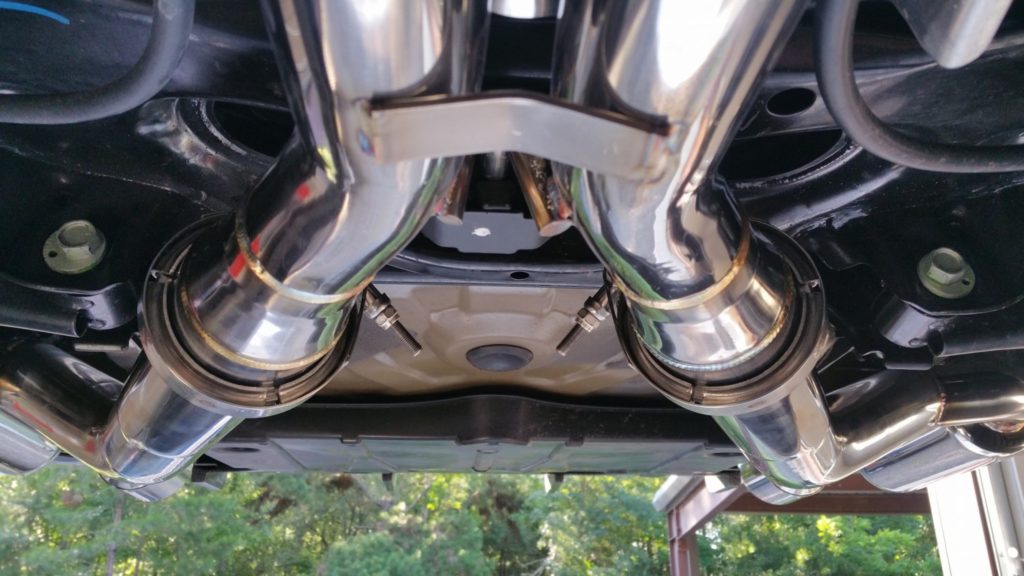
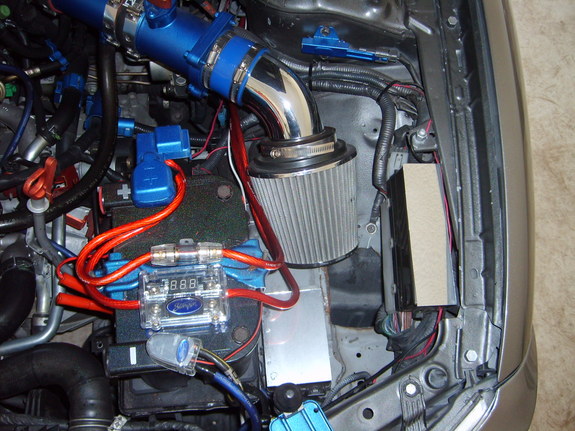
This is the battery relocation for the 2002/2003 Nissan Maxima. However, I’m sure it will work for the other gens too since it’s basically the same. I did this on my 5.5 and my boys 5.5 gen Max.
This set up is for people that already have a aftermarket intake. If you are running the Injen intake, like I was, then you can use it. Using your Injen intake you will need to get another midpipe ( berk, frankencar etc…) and another coupling.
1) First of all turn your wheel all the way to the right.
2) Remove your Intake and next you need to remove your battery.
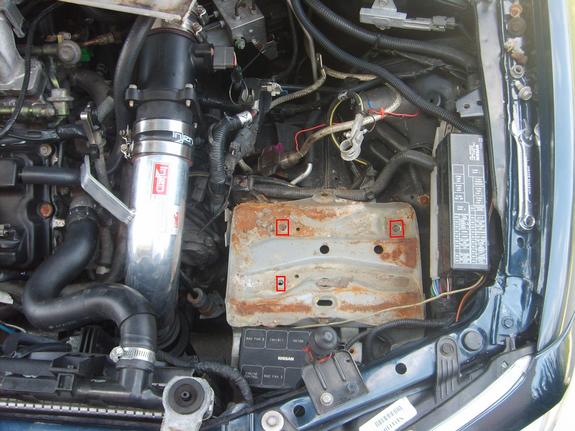
3) Remove the plastic cover, this will expose the (3) screws holding down
the battery tray. Take those out.
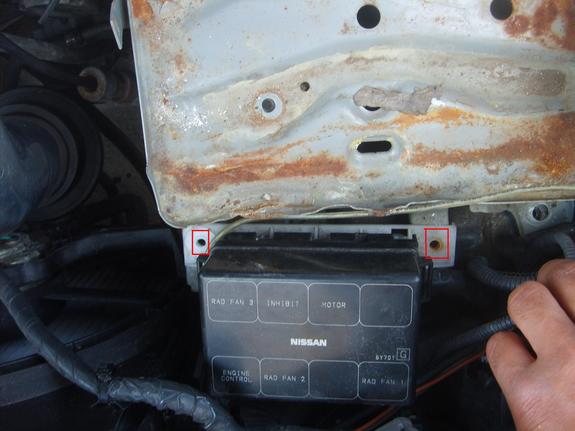
4) After removing the screws you will need to remove the fuse box. It is
held in place by two screws.
5) Looking at the tray you will see that the Positive terminal cable is
attached. Just pinch the zip tie and push it out. You should be able to
pull the tray out.
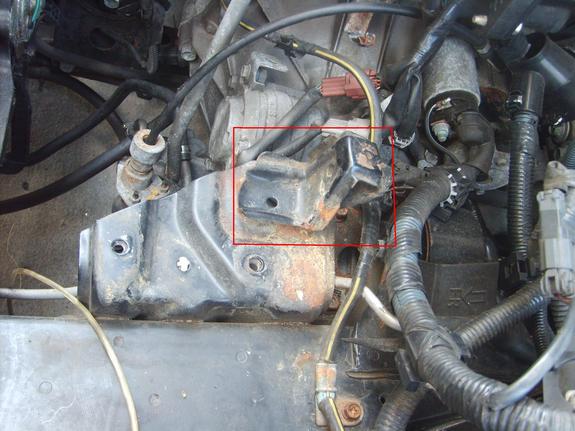
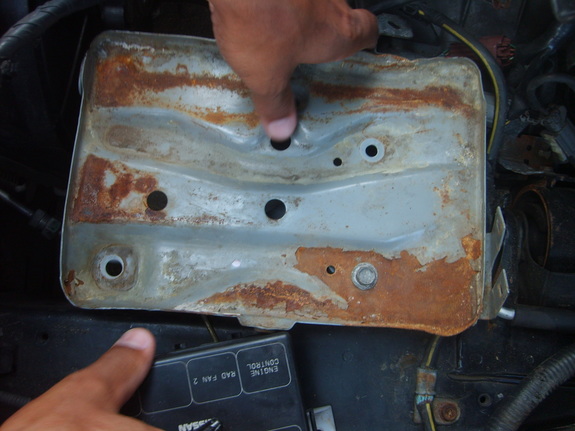
6) When you pull the tray out you’ll see that it has mounting points for the
fuse box, the positive terminal mounts and where the tray mounted to
the car. ALL of these need to be cut off. Use your dremel to accomplish
this. Now is the time for this kid to get his sanding and painting skills on.
7) Looking at where the tray was you’ll see a raised piece. This needs to
get cut off to make the surface flat. Just use the dremel to cut it off. If
you look close you’ll see small circle’s. This is the tack weld, lightly cut
over that circle and wedge your screw driver and pry it up. Take your
pliers and start turning it in a circle motion and it will pop right off.
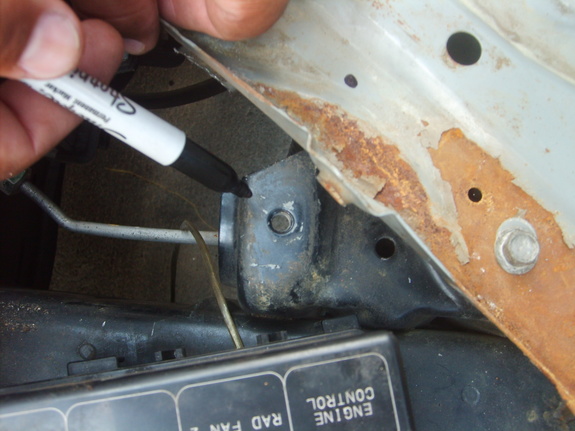
8) Place your battery tray to sit parallel on the mounting point. You will use on of the existing holes to mount this.
9) Once you have it aligned slightly pick up the tray and you’ll see where the other screw will go. Use your sharpie to mark the spot in relation to the tray on the tray. Once this is marked take your tray off and drill out the spot where you just marked. Use the 17/64th drill bit to drill out the spot.
After you drill it out lay it in place to make sure it lines up perfectly. If it does then straight, if not check your alignment and drill it out. This is enough to secure the weight of the battery with NO problems. Do not secure the battery tray down just yet.
Next is aligning the fuse box.
10) Parallel the fuse box and push it snuggly against the battery tray. You will see where the original mounting point on the fuse box was. You are going to use it again. Take your sharpie, mark the spot and move it to the side. Take your drill and 17/64th drill bit and drill out the hole. Don’t worry there is nothing there but space. Put the fuse box in place and use your 17/64th bolt to secure it down.
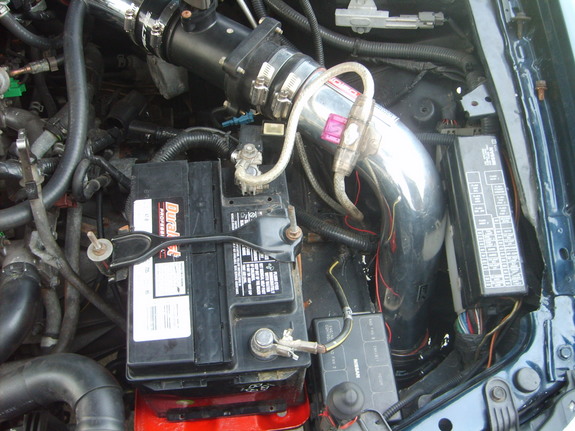
This is what it should look like when you are done.
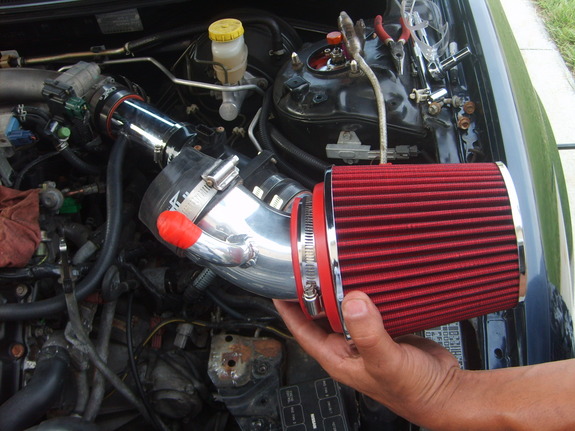
Now turn your INJEN WAI into a CAI.You will need a new midpipe and coupler to make this happen.
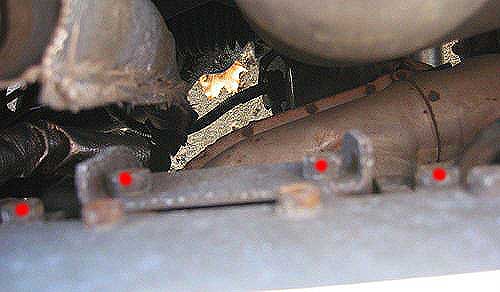
You have all this space to work with. Up underneath is open space. You will take your dremel and cut out a triangle shape, smiley face, whatever you like. J/K cut out a circle large enough for your piping to go through.
1) DO NOT go beyond this red line, you will be cutting into the frame. I found it easier to use a drill and drill holes, then take the dremel and cut the lines. Take your pliers and catch a corner and start turning in a circle. It will role up and come out easier. You can take your dremel and clean up the edges when you have finished.
2) Assemble your intake set up. Coupling, new midpipe, coupling, MAF, coupling, Long elbow of the Injen intake, coupling. You will assemble the Injen midpipe and filter inside the fender.
3) The Injen midpipe has a line for the vacuum. You will need to block this. I used some gasket making material. Also, on the long piping of the Injen there is the mounting point that you will need to cut off. You don’t have to but it looks better.
4) Place your intake set up in place.
5) After extending the piping into the fender you will need to pull the fender plastic towards you. You will see the piping coming down. You will then connect the Injen midpipe and filter to the piping coming in. This completes your intake set up.
note: Make sure all your couplers have been tightened down. Also, make sure you hook the vacuum line back up.
6) Everything is finished. Put your battery tray back on, secure it in place.
7) Put your fuse box in place and bolt it down.
8) Connect your battery negative and positive and your set.
The SSIM (Secret Sauce Intake Manifold) was created years ago by member SR20DEN. This involves cutting the shelf out of the main chamber of the upper intake manifold and removing the VIAS assembly. This will still lose a little low end power, but the gains in the top end are very noticeable. It’s definitely a modification that is worthwhile.
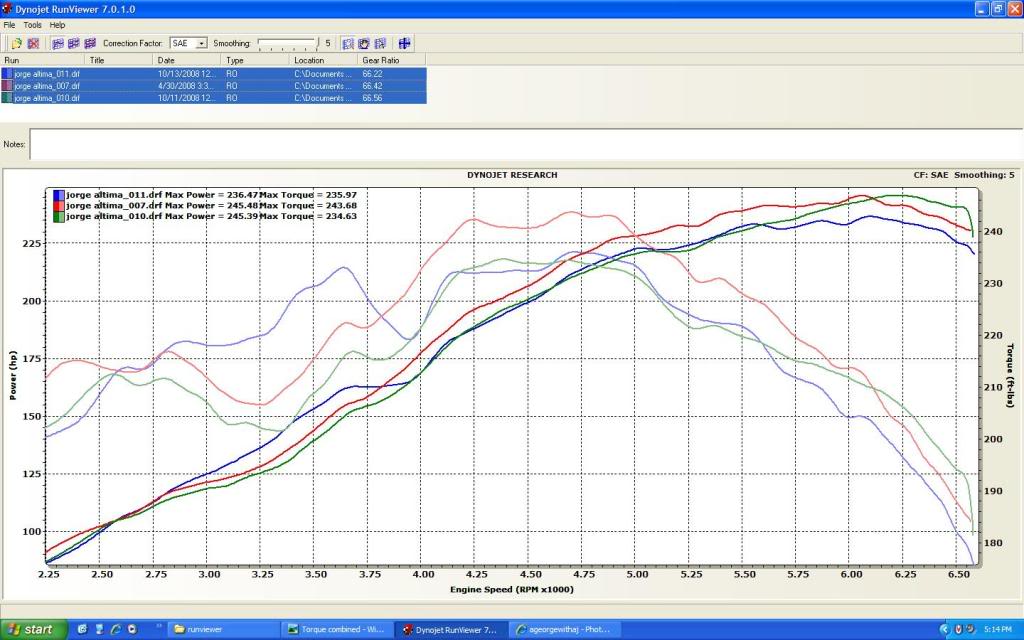
Below are the results of 3 different Intake Manifold setups. All runs done on the same dyno with the same AFR (tuned for 13) and around the same temp. Stock (runfile11), SSIM (runfile10), VIAS delete (runfile7). Your constructive input is welcome but I am not here to argue about any of my results, this is what I did and that is what I got end of story so please no flaming. Enjoy!!!
Stock IM with functional VIAS.
Stock IM with VIAS deleted, NWP Block plate used.
SSIM with VIAS deleted, NWP Block plate used.
All three HP overlay.
All three TQ overlay.
All data combined.
My thoughts on the SSIM vs Stock.
First of all I am suprised that the SSIM did so poorly when compared to both the Stock setup and the VIAS delete.
It posted losses across the board, it only begun to edge out the stock setup after 5600rpm with a gain of 12hp
at 6300rpm.
Against the VIAS delete setup it made the same peak power but posted some gains after 6100rpm, average of 5hp with a peak of 7hp at 6500.
It was totally killed by the Stock setup from 2500rpm until 3800rpm, max of 24tq at 3400rpm. Never made any gains in usable torque.
Killed by the Stock setup for HP as well, losses from 2500rpm until 3900rpm, an average of 10hp with a peak of 16hp at 3500rpm lost to the stock setup.
From 3900 until 5600 they were about the same.
My thoughts on the VIAS delete vs Stock.
3800rpm seems to be the magic number in this comparison. Below 3800 the Stock setup is better but after that its all gains with the NWP Blockplate and the VIAS delete!!!
From 3800 all the way to redline with the VIAS delete I showed an average 8hp gain across the board with a peak of 10.5hp at 6000.
From 2700 until 3800 the Stock setup was good for an average of 8hp over the VIAS delete with a peak of 9hp at 3400.
From 3800 until redline the VIAS delete made an average of 8tq more with a peak of 10.5tq at 4200.
From 2800 until 3800 the Stock setup was good for an average of 10tq more with a peak of 16tq more at 3400.
The verdict….. Its really just up to what you want to drive with, I am choosing the NWP Block plate with an unmodifed IM for now.
I like the power from 3800rpm until redline rather than power below 3800rpm, I feel the losses down that low are worth the gains I see up high. When I stomp on the gas I dont stay below 3800 for very long, this makes the VIAS delete a beneficial mod IMHO.
The gains from the SSIM is irrelevant since it only starts to make HP after 6100rpm and totally destroyed all low end torque. Since I run out of engine the SSIM may be a viable option with a TS ECU and a higher redline, timing etc, etc.
This is a gallery of Secret Sauce Intake Manifold (SSIM) Setups. The SSIM (Secret Sauce Intake Manifold) was created years ago by member SR20DEN. This involves cutting the shelf out of the main chamber of the upper intake manifold and removing the VIAS assembly. This will still lose a little low end power, but the gains in the top end are very noticeable. It’s definitely a modification that is worthwhile.
Hey guys. I was really interested in the Ghetto Air Box (GAB) but did not want to destroy the filter holder (>65 dollar value according to Dave B) So I thought up a way to create the same thing without cutting part of the holder off. This may have been thought up before but I didn’t know about it.
First you will need the following:
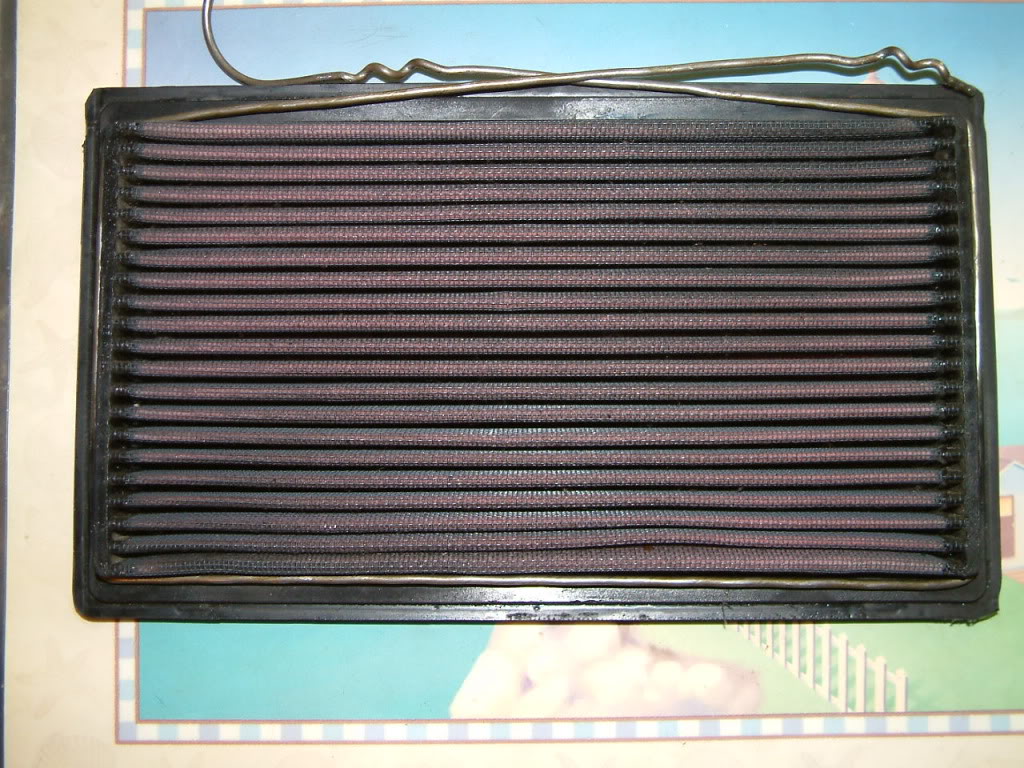
The basic tools, a hanger (I used a thick gauge one), black sharpie, and of course your filter (Mine is the K&N one):
Unwind the hanger as shown below:
Straighten up the hanger as best as you can:
Now you want to center the hanger at the bottom of the filter and mark on the hanger where the side of the filter is like seen in this picture below:
Now bend the hanger in a 90 degree angle like so:
Do the same thing for the other side (Make sure the hanger is fairly flat against the filter):
Now mark the top part of the hanger where the top part of the filter is and bend those in at 90 degree angles too:
Now move in about 2-3 inches and bend the hanger away from the filter like seen in the picture. Then move out about 1-2 inches away from filter or about 0.5 inches more than the distance from your filter (where the hanger is at) to the edge of the opening that’s near the headlight (yeah this is a little confusing) See two pictures below for a better understanding.
Stick the filter in and then mark the hanger hangs back out like seen:
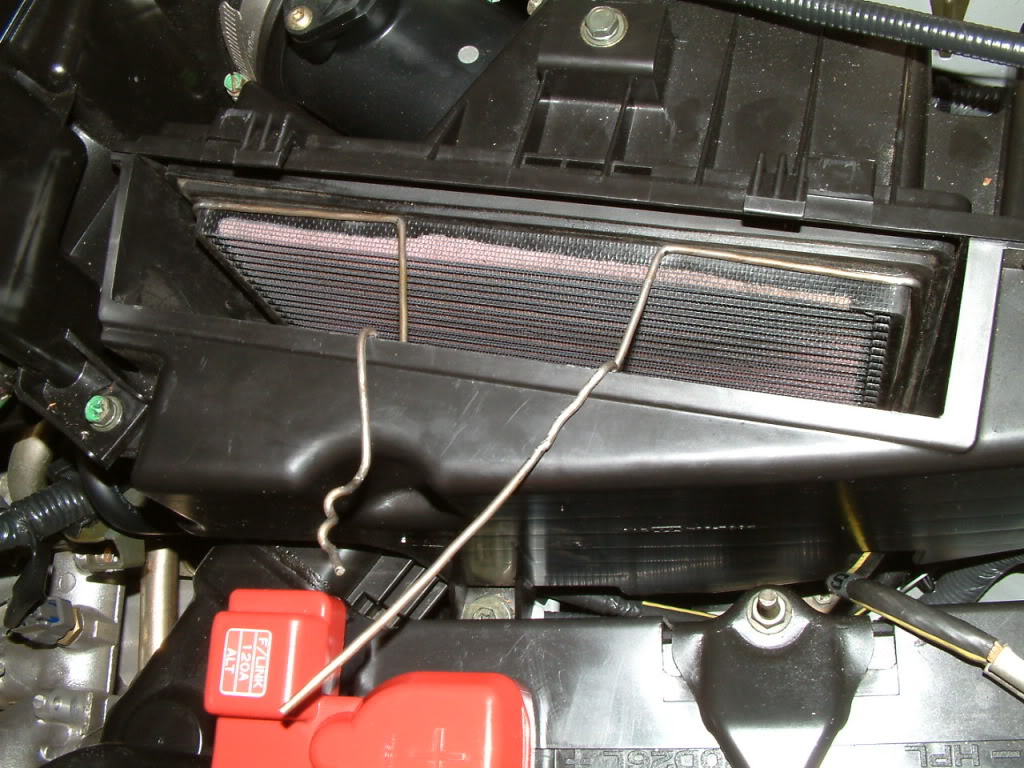
After marking the hanger go and bend it so it goes around the lip of the opening of the air box like seen below:
The final product:
and a close-up of it
I haven’t cut the ends off yet. Another thing I am going to do is add electrical tape around the hanger just so it looks better and some extra around the area where the hanger is now hooked onto the air box opening. But I’d figure this will help those out there that are wanting to do this mod but not wanting to cut their filter holder or just have the really ugly duck tape holding it in.Butt feeling of this is that it feels like the car can breathe a lot better and seems to have better response even in low end.
A) A knock sensor is a specially designed listening device for car engines. It listens for engine knock, or detonation (pinging). Detonation can be very bad for an engine and is the result of the fuel/air mixture exploding too quickly instead of burning evenly and rapidly. This is due to either bad fuel, ignition timing which is too high, or built up carbon deposits in the engine (which increases the compression ratio). The sensor is small and consists of a piezoelectric sensor that listens for knock by detecting pressure. It is very sensitive and can be considered worthless if dropped. The vibrational pressure is then converted into a voltage and sent to the ECU for evaluation.
Q) How do I know if my knock sensor is bad?
A) Symptoms of a bad knock sensor include a sluggish engine, poor acceleration and poor fuel economy. Knock sensors rarely fail outright and more often get “soft” over time and cause false signals to be sent to the ECU, which thinks the engine is knocking when it’s really not. Thus, the ECU will reduce the ignition timing to the engine. The knock sensor on the VE30DE is prone to corrosion of the terminals and harness connection. This is due to the harness weather seal getting brittle and cracking, allowing moisture to seep into the harness from the rear and corrode the terminals. This creates a poor connection and faulty voltage readings to the ECU.
Q) How do I test my knock sensor?
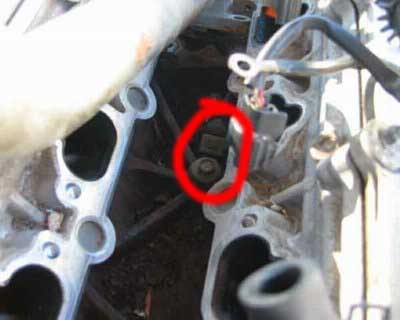
A) The knock sensor voltage can be checked through an electrical harness located right above the thermostat housing (where the lower radiator coolant hose attaches to the engine). It is a gray connector with an orangish red cap with two wires. Unplug the connector and attach a multimeter (or voltmeter) to the lower harness (the male connector). The wire for this connector should go left and underneath the intake manifold. Check the front most terminal (see pic) and ground out the negative point. You must have a multimeter than can measure more than 10 M ohms. Continuity should exist. This method is per the Factory Service Manual. NOTE : Knock sensors should be considered regular maintenance items. If you have over 100K miles and have never replaced the knock sensor, you can probably consider it bad.
Q) What parts will I need?
A) For knock sensor replacement only, here are the required parts:
-Normal hand tools (8, 10, 12mm sockets, long extensions, 14mm open-end wrench, large adjustable wrench, torque wrench, Philips screwdriver, 6mm hex key socket (I THINK this is right, check the size of the intake plenum hex bolts first to see if it fits before you start)).
-Coolant and distilled water (about a gallon total)
-Knock sensor PN 22060-30P00
-Knock sensor sub harness PN 24078-30P00
-Throttle body gasket PN 16175-53J00
-Intake plenum gasket PN 14032-97E00
-2 Intake manifold gaskets PN 14035-97E00
-Liquid gasket which is impervious to coolant (high-temp)
Q) What are some other things I could do while I’m in there?
A) Since you will be draining some coolant and releasing the fuel pressure, here are some things you should think about doing (though not required):
-Replace all fuel lines with rubber fuel injection hose (don’t get normal fuel line since they are not reinforced for high-pressure fuel injection systems).
-Replace all coolant hoses (radiator hoses, bypass hoses, throttle body hoses, there are a lot of small ones that are very difficult to get to normally, this is your chance to do it easily)
-New vacuum hoses (you’ll need at least 8 ft I believe, there are a lot of small ones)
-Fuel injectors: Might want to get them cleaned and install new o-rings and grommets
-Fuel filter, since the fuel pressure is released, why not?
-Port match intake manifold/plenum and throttle body
-New coolant temp sensor
-New PCV valve
-New thermostat
Q) I’ve never done major work on a car. Can I do this successfully?
A) Replacing a knock sensor isn’t necessarily hard work, but it is time-consuming. As long as you think the project over beforehand and label everything you disassemble, you should go fine. The worst thing that can happen is you end up with a loose hose somewhere or have an intake or coolant leak.
Now the fun part, actually doing the job! These procedures were produced from my 93 SE 5spd. If you have an auto, you might not have as many vacuum lines to disconnect since the 5spds have the power valve and purge canister.
Release fuel pressure
The FSM states that to release the fuel pressure, you need to remove the fuel pump fuse located in the interior of the car under the panel by your left knee when you’re sitting in the driver’s seat. Crank the engine up, let it die, then crank it a few more times until it doesn’t start. Then take out the key and replace the fuse.
Drain coolant
On the bottom right side of the radiator is the drain cock (plastic t-handle with a small clear rubber hose hanging down). Open the drain cock and allow about 3-4 quarts of coolant out. You don’t need to drain the entire engine since the intake manifold only holds a small amount of coolant, and this is the first part to drain since it’s highest on the engine. Remember to shut the drain cock!
Disconnect battery
Very important! You will have open fuel lines, so one spark could start a fire! Remember to disconnect the negative cable first.
Disconnect intake and air box
-Unclamp the 4 latches on the air box as if you were changing your air filter
-Loosen the throttle body air intake tube clamp
-Unclamp the two big rubber breather hose attached to the plastic air intake tube.
-Unhook the two vacuum lines attached to the resonator, then lift the entire air intake unit out and out of the way
Disconnect blow-by tube
This is the small, long metal tube attached to the front of the intake plenum
-Unbolt two 10mm bolts and two rubber hoses.
-Carefully unhook the wiring harness clamps. These are very brittle and if not already broken, will break if you force them! Have some zip ties ready if you do break them
Throttle Body
Just disconnecting the throttle body is the easiest way to do this. You can leave the TB attached but then you must remove many vacuum and coolant lines from it. It’s easiest just to remove it and lay it on the side.
-Remove the throttle and cruise control cables by loosening the left nut with your 14mm open-end wrench (furthest from throttle body, if you loosen the right nut you can change the tension on the cable, not good!). Then remove the cable from the TB bracket.
-Remove a short vacuum hose on the bottom of the TB that connects to the intake plenum
-Remove the 4 hex bolts using a criss-cross pattern and remove the TB
-For added stretch you might have to unclip the TPS harness from its mount
Intake Plenum
-Unplug and remove the three rear coil packs
-Remove three ground straps (10mm bolts) 2 on front of plenum, one on left side *Take a dremel or steel wool or something and clean these ground straps and mounts to get the oxidation off, these need to make good grounds!*
-Remove the vacuum hose from the power valve on the left side of the plenum (N/A for auto)
-Remove the tiny cruise control vacuum hose from the rear of the plenum
-Remove the mid-size vacuum hose on the rear of the plenum that routes to the brake booster
-Remove the mid-size vacuum hose right underneath that (this one meets a metal pipe which eventually winds up at the PCV valve.
-Now, remove the two 12mm bolts that this PCV metal pipe connects to the plenum with
-While you’re down there, remove the two 12mm top bolts of each plenum stiffening plate (only one plate is shown in the picture, there is another to the right by the EGR)
-Take your big adjustable wrench and crack the big nut loose on the EGR valve. Loosen it all the way until it moves freely and you can see a gap between the EGR valve and metal EGR tube
-Remove the 4 remaining vacuum lines by the throttle body location.
-This one’s hard to see, but there are 4 12mm bolts holding on the EGRC valve on the lower right side of the plenum. Two on the right side, two on the back side (one is not visible in the pic)
-Remove the 10mm bolt holding on a metal vacuum line mount on the right side of the plenum, in front of the throttle body. It has a yellow sticker on the mount.
-Now all you have to do is crack loose the 6 hex nuts in a criss-cross pattern and pull off the plenum! If it doesn’t come off freely, hit the “Nissan” part lightly with the palm of your hand. Now, when removing the plenum, make sure everything is disconnected before you rip something off
Fuel Rails
-Loosen the screw clamps for each of the 4 small fuel lines (2 on each rail)
-Remove the fuel “T” line on the left side by removing the two 10mm bolts. Be careful not to drop these down the intake manifold as you’ll have to fish it out of the intake port of the head if you do (speaking from experience here)
-Break loose the fuel lines and be prepared for some fuel to spill out. Have rags handy. Remove the fuel “T”
-Now remove the 4 hex bolts of the fuel rails. Be prepared to gather a plastic spacer and metal washer for each bolt as they will fall and get lost easily. Remember how they fit! Plastic washer on bottom, then fuel rail, then metal washer on top, then bolt.
-Lightly pull up on the rails, when they are loose you can remove the right fuel lines. Do not drop the fuel rails, injectors are fragile and expensive!
-Watch for any loose fuel injector grommets (where the fuel injectors sit in on the manifold). Don’t lose these unless you have new ones ready to go.
Intake Manifold
-Remove the left radiator hose and the smaller bypass hose right next to it. You only have to disconnect them from where they meet the manifold
-On the right side, remove the three bolts that hold on the coolant tubes to the right side of the manifold. You may have to pry a bit to get this off as it’s sealed on with liquid gasket.
-Disconnect the coolant temp sensors (big one and small one, be careful as these electrical connectors are brittle, and you’ll have to pry the small metal wire clip to remove it)
-Now crack loose the 4 nuts (not bolts yet!) in a criss-cross pattern, 2 on each side of the manifold
-Now loosen the 6 hex bolts, again in a criss-cross pattern (important, you don’t want to warp the manifold by improper untorquing)
-Make sure you gather the washers that go with the nuts
-Pop off the manifold (you might have to pry a bit)
Water Pipe
By now, you can see the knock sensor and the pile of crud in the valley of your engine, but there’s no way to break the sensor bolt loose because the water pipe is in the way!
-Remove the two nuts and washers on the left side (connecting to the water pump)
-Remove the two bolts that bolt vertically down into the engine block on the right side.
-Now, using a LARGE flathead screwdriver, pry the water pipe off the studs on the water pump side and you’ll be able to hold the water pipe up to get to the knock sensor. Much easier than removing the thermostat housing and all those coolant lines on the right side
Knock Sensor
Finally, one bolt and it’s off. Clean the contact point thoroughly since any dirt or gunk will make the sensor less effective. Now, put the new sensor in and BE CAREFUL with it. Remember not to drop it or hit it against anything. Even when bolting it down take extreme care, you do NOT want to over tighten it! I couldn’t find a torque figure in the FSM so I just tightened it down until I felt resistance and went about another half turn. My uncalibrated torque right arm says it was about 15-20 lb/ft.
Now it’s time to clan the gasket surfaces on the head, manifold, plenum and throttle body. Use a paint scraper for the best results. A bit a steel wool won’t hurt either. Make sure no debris or anything falls into the intake ports in the head. Also clean off the water pipe where it was sealed with liquid gasket
Installation is in the reverse order of removal. Use a solid bead of liquid gasket on all surfaces. Completely circle around all pipes (on the right side of the intake manifold, the coolant pipes that attach have two pipes. Make a circle around each hole so they don’t leak into each other). Don’t use TOO much liquid gasket though. A thin solid bead is all that is needed. Allow at least an hour for it to dry (by the time you get everything else back together, at least an hour will have passed)
Intake manifold torque for the hex bolts is 20 ft/pounds. For the 4 nuts it is 24 ft/pounds.
Again, torque them in a criss-cross pattern (middle bottom left, middle top right, middle bottom right, middle top left, far bottom left, etc)
Fuel rail bolt torque is 20 ft/lbs
Intake manifold hex bolt torque is 20 ft/lbs. Criss-cross pattern.
Throttle body torque is 15 ft/lbs, criss-cross pattern
Make sure you replace all the plastic spacers and washers correctly when you replace the fuel rails.
When replacing your coolant, fill it up to the top of the radiator cap. Now, carefully open the 10mm nut by the large coolant bypass hose on the right side of the intake manifold (by the two pipes and the coolant temp sensors). This is a purge valve and releases the air in the system as you fill it up.
Start it up and check for leaks. When all done, take it for an easy test drive quick around the block then check for leaks when you return. On the first real drive, drive slowly as if you were breaking the car in. The metal manifold gaskets need a complete heat cycle to seal correctly. You don’t want to risk doing this over again! Then disconnect the battery (negative first, then positive) and let it sit overnight. In the morning, enjoy your newfound VE power!
The Rubik’s Cube is the most popular puzzle on the World. Learn how to solve it with the easiest method.
Below is the distributor hold-down bolt which resides under the distributor, you can see the sun shining on it in both pictures. To change the timing:
First obtain a timing gun (normal or one with the advance feature)
Make sure the engine is warmed up and running at a normal idle level [during the whole procedure].
Hook the #1 cylinder up to the timing gun and the two terminals to the battery.
Check your current timing by aiming the timing gun near the belts on the right side of your car directly on the crankshaft pulley. There are 7 tick marks, starting from the left (closest to the windshield) 0, 5, 10, 15, 20, 25, 30 degrees. The first tick mark is technically supposed to be orange, but might be covered up from dirt.
There is a timing indicator (I call it an arrow) which indicates where your timing is when the light from the gun is flashing on it. If you see the arrow on the middle mark (4 from the left when standing at the right front tire), then your timing is right at 15 degrees.
Remove the “ECCS” cover.
Obtain a 9 mmsocket with an extension and loosen the below distributor hold-down bolt.
a. Be careful to keep the wires away from the accessory belts or cooling fans b. Do not take the screw out, only loosen it a little.
Once the screw is loosened, put your hand on the distributor and slightly turn it to the right (advancing). Have the nut on the distributor snug enough where it stays in place for fine tuning.
Next, check your timing with the gun. I recommend going with 20 degrees, which is the 3rd tick mark from the right (5th tick mark from the left). 18 is also a good number and you can adjust accordingly for it.
Tighten the distributor hold-down bolt
Re-check the timing to ensure the distributor stayed in place while you tightened it.
Disconnect the timing gun
Put the distributor cover back on.
Take the car for a test drive and make sure no knocking or pinging occurs. If it does, retard the timing slightly.
Note 1 If you have an advance able timing gun, you can use it’s feature, which allows you to dial the timing in on the gun itself and base everything on the left-most tick mark. With this setup, you really don’t need to use the advance feature and can just use the tick marks. The only advantage in my eyes with using the advance feature is that it is a little more easy to determine the left most mark than the 3rd mark from the right (20 degrees)
Note 2 Higher octane fuel is recommended with the advanced timing setup. I alternate between 89 and 93 octane and haven’t had any problems.
( standing at the right front wheel looking down at the crankshaft pulley) excuse my art work.
Anyone ever get that $300 – $500 quote to have your alternator replaced? One word of advice: Don’t fall into that trap. The new Hitachi (Nissan OEM) alternators run about $220 and have a limited warranty. Another alternative is to purchase a higher line remanufactured alternator, which is much cheaper. They utilize the same Hitachi case, offer similar reliability, and in most cases, come with a lifetime warranty. I purchased my remanufactured alternator for $80 .
I have installed remanufactured alternators on both of my Maximas with good results. Two months ago, I put one in my black Maxima, these are the instructions I followed. They are mostly from a Tune-Up & Repair Manual designed specifically for the 1989 – 1990 Nissan Maxima. I use this in conjunction with my Factory Service Manual. I do not guarantee or warranty results, please do this at your own risk.
These instructions include the removal and replacement of the air conditioning and power steering belts as well. These extra steps are in red. You will need:
alternator
power steering, air conditioner, alternator belts
Jack, jack stands
10 mm, 12 mm, and 14 mm sockets with short, medium, and long extensions, and a ratchet
eye protection
Step 1: Disconnect the Battery .
disconnect the negative, then the positive battery terminal.
Step 2: Loosen the nut in the center of the air-conditioning belt idler pulley .
it’s the top most pulley, located on the right end of the engine.
Two or three turns is all that is needed.
This will allow the belt to loosen when you loosen the tensioner bolt
Step 3: Loosen the air-conditioning belt tensioner bolt
This 12 mm adjuster is located above and to the left of the pulley
Loosen around 15 turns or enough slack to remove and install a new belt.
Step 4: Raise and support the front of the car
Use caution with a level ground, appropriate jack and jack stands.
Turn the front wheels to the right after jacking up the car.
Do not use the spare tire jack.
Step 5: Remove the lower right splash shield
From beneath the car, unscrew the 10 mm bolts.
Step 6: Remove the splash shield from the right wheel well .
The shield is again, held in place by 3 10 mm bolts and a push-in clip.
The bolts and clip are located behind the right wheel.
It is not necessary to take off the wheel – I did not.
Personally, I question whether it is necessary to take off this shield.
Step 7: Remove the Air conditioning belt
take it off the crankshaft pulley first, and then the air conditioning compressor pulley.
Step 8: Loosen the bolt on the alternator belt tension rod .
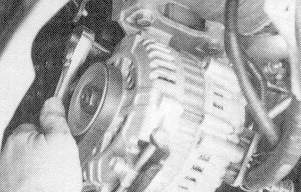
On the bottom of the alternator, you will see a bolt and a metal device that it is in. Loosen the nut that is holding the bolt. (the nut facing the right tire).
Step 9: Loosen the alternator pivot bolts .
There are two of these bolts, and they are at the top of the alternator (one on each side, in line with each other).
Step 10: Relax the tension on the alternator belt.
Loosen the alternator belt adjuster and squeeze the belt together to move the alternator toward the engine.
Note: the alternator may be hard to move, just keep working it, until it loosens
Step 11: Remove the alternator belt.
Step 12: Unplug the large connector .
Press in on the tab on the connector and pull it out of the alternator
Step 13: Disconnect the wires from the rear of the alternator .
Unscrew the nuts that attach the wires, and pull the wires off their studs.
Watch for falling debris in your eyes.
Step 14: Free the alternator harness clamp .
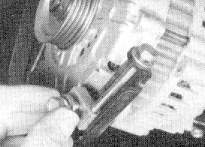
Remove the 8 mm bolt that attaches the clamp to the rear of the alternator.
Step 15: Remove the adjuster bracket from the alternator
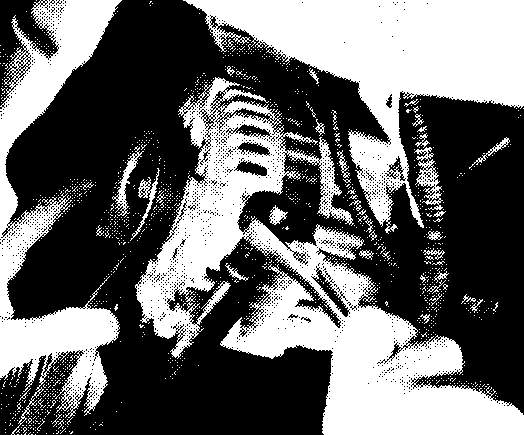
Unscrew the bolt that attaches the adjuster rod and bracket to the bottom of the alternator.
Step 16: Remove the alternator pivot bolts.
There is a second bolt at the rear of the alternator (identical to the easier viewed one), directly in line with the front one.
Remove both, securing the alternator with your hand so it doesn’t fall on you.
Step 17: Remove the alternator
I had trouble getting mine out and had to push back and forth until it finally came loose.
At this time you can remove and replace the power steering belt. The tensioner is in view.
Step 18: Install the new alternator .
Install the bolts above the alternator, finger tight at first.
Do not tighten these until the alternator belt tension has been adjusted.
Step 19: Attach the lower adjuster bracket .
Screw in the bolt that attaches the adjuster rod and bracket to the alternator
Step 20: Connect the large wire to the alternator .
It mounts on the upper stud.
Step 21: Connect the small wire to the rear of the alternator .
The small wire mounts on the lower stud.
Step 22: Attach the alternator harness clamp.
Step 23: Plug in the large connector
Press the connector into the alternator until the tab locks it in place.
Step 24: Install and tighten the alternator belt.
Tighten the adjuster nut until you can deflect the belt ¼ – ½ inch midway between the pulleys.
Step 25: Tighten the pivot bolts.
again, the bolts above the alternator.
Step 26: Install the air conditioning belt.
assure that the grooves and ridges in belt match up with the grooves on the pulley.
Step 27: Install the splash shield on the right wheel well.
Step 28: Install the lower splash shield .
Step 29: Lower the car .
Step 30: Adjust the air conditioning belt .
from the top, turn adjuster bolt clockwise until you can push the belt inward about ¼ inch.
Again, this adjusting nut is 12 mm just above the air conditioning idler pulley.
Step 31: Tighten the pulley bolt.
this locks the tensioner and prevents it from loosening.