
![]()
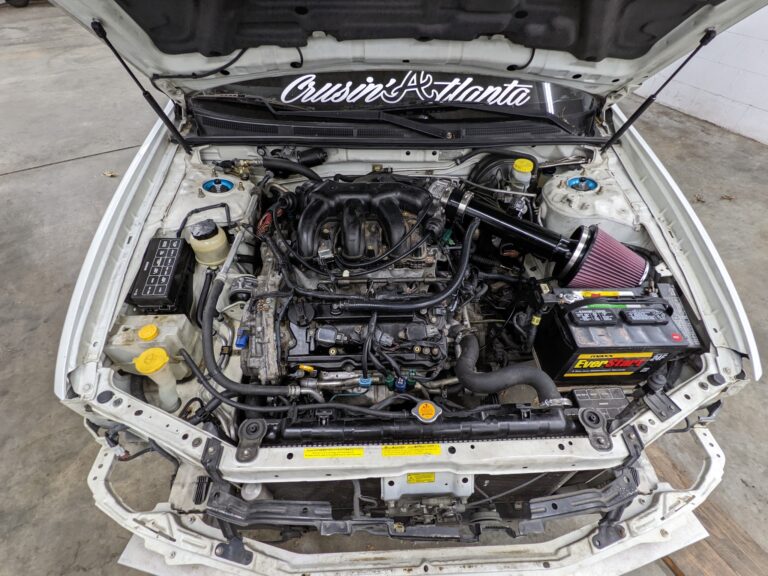
Owner: Charles G.
Year: 2005
Model: Altima
Color: Bayside Blue
Engine: VQ35DE
Transmission: 6-Speed Manual
Trim: SE-R


![]()
Credit: Ahmed H.
This is something I posted in another group. Here is a small informative write up on something I ran into little while back.
Here are two different GTR injectors. One is claimed to be as “remanufactured GTR injector” and the other one is as real GTR fuel injector that I removed from a customers car.
As a tuner we often have cars brought in and deal with different brands of fuel injectors which is fine as long as the injectors are consistent across the board and it is incredibly helpful if they are normally supplied with a data sheet. Such as flow matching, minimal injector pulse with, fuel injector dead time, injector PW compensation, pressure differential dead time etc.
This customer asked me to tune their G37 with “reman” GTR injectors but I had requested that I would see them prior to installing them.
Just looking them over, you can clearly tell which one is the fake “GTR” injector. The molding is different, the brand logo is slightly off, the area where the Oring sits is very off, the spray pattern cap isn’t drilled at the correct angle, and what really gave it away as soon as I took it out of the box was the electrical terminals and connector.
So why is it important to run a known matched/reputable set of injectors? For many reasons, but one of which is drivability. As a tuner, we can tune a set of injectors on the dyno, to try to give you as much of the OEM drivability and consistency as possible. But with low quality fuel injector, you will end up with sporadic drivability after the car is off the dyno and in real world driving conditions. Some of the issues that can be encountered with knock offs are fuel trims will constantly change (sporadic), check engine light DTC, power loss, misfires, lean conditions, per cylinder fueling will be off etc. the list of issues can be very long.
Couple of the reasons for these knock off parts causes these issues is their inconsistency of performance due to voltage change, temperatures change, and being closely flow matched at low injector duty cycle such as idle, light throttle, cruising conditions, etc.
Here’s an example: let’s say at idles, your engine needs 2 milliseconds worth of fueling. Your tuner has input all the right data for the injector on the dyno. After getting the engine warmed up, now your tuner will adjusts the fuel table to get a good idles and stable fuel trims.
Let’s also say you bought the knock off injectors you were warned not to buy. Looking at the data, you’re idling at 2 milli seconds when the engine is warm. You drive the car home, next morning you start the car and it cranks for a while before it starts then after it starts you get weird misfires. Knock injectors can easily change in operation by .5 milliseconds. Doesn’t sound like much but that 25% of your fueling at idle. Things get works when you turn on the A/C, radio, and defroster.
The cars ECU can usually accommodate up to 25% of fueling at low loads, but will worsen as voltage changes and engine operating temperature changes. The reason is the injectors are performing different at different temperatures. This is why OEM and quality brands spend so much time developing their injectors. to give you that optimal consistent cold start, hot start, idle, drivability etc.
Just remember, the reason your car has poor drivability is probably because of your knock offs injectors, not necessarily your tuners fault.
The fueling will be much closer to target fueling under WOT as this .5 milliseconds becomes a much smaller percentage and less noticeable. This is something to look into if your car only runs great at WOT and nowhere else.
Hope this helps saves you from having to deal with a future hassle. P.S. of course Fb took a lot of the resolution away from these pics. Also, the real injector is on the left of you have noticed.
Cheers!

Fake

Real

![]()
Ever wondered what it would look like if your car was turned into a collectible figurine? With Google Gemini, you can experiment with AI-powered creativity in just a few simple steps. All you need is a photo of your car and a fun idea to bring it to life.


![]()
Community Member Credit: twiggy144 / khemraj1999
The rear O2 sensor (downstream of the cat) failed. I had both codes 0512 and then 0912. This lights up the SES warning lamp, but the ECM does not use any other signal from the rear O2 sensor as input to manage the fuel and ignition system in a closed-loop operation. The only purpose of the rear O2 sensor is to monitor the function of the catalyst. So I didn’t care much about having a functioning rear O2 sensor. I wanted a creative solution to turn off the SES lamp. A search on eBay resulted in an “O2 sensor simulator”.
I ordered one unit and installed it. My installation also included 2 additional 25 ohms resistors rated for 15 Watt load to simulate the O2 heater function. The ECM also monitors the heater function of the O2 sensor. So I had to take care of that error code as well to have the ECM turn off the SES lamp. I tapped in the 2 resistors in series in place of the heater wires. As an alternate to resistors, I think a simple 12V 3Watt automotive bulb ( No 194) could have simulated the heater function of the O2 sensor.
The whole installation went smooth, and the ECM switched off the SES lamp. I recommend very much the DualO2Sim. It costs much less than a genuine rear O2 sensor. Please remember this simulator works only for the rear (post catalyst) O2 sensor.
The simulator is offered at $30. A genuine O2 sensor costs at least $60. I can make a write-up. I will post it later.
Wanted to share my experience with all.
The rear O2 sensor has 4 wires (on my 1998 Maxima).
Cut all 4 wires of the O2 sensor. Cut the wires close to the bad O2 sensor. That will give you some good wire length after the connector located under the driver’s seat. (On my 1998 Maxima the connector is located under the driver’s seat. This is where the O2 sensor wires emerge from under the car through a rubber grommet). Leave the bad O2 sensor in the exhaust pipe.
The sensor simulator also has 4 wires:
Use a voltmeter to identify which of the white wires above (3- or 4- ) is the +12V feed. The voltmeter will show a +12V signal with wire 3-. Connect this wire with wire a-.
Connect wire 1- with wire c- or d-. (My car only had one O2 sensor ). Leave the other purple wire unconnected if you have only one rear O2 sensor.
That will take care of ECM code 0512 Downstream oxygen sensor high voltage fault.
In my case, I also had to simulate a functioning O2 sensor heater. I used 2 x 25 ohms resistors (rated for 20 watts each) and connected in series them between wires 3 and 4. Polarity is not important for these. Under 12 V these should dissipate 1.5 Watt each, with 0.24 amps running through them. Be careful where you locate these because they get hot. Not burning hot, but hot. I tied these down under the driver’s seat. I estimated this area had enough open air to dissipate the heat. That took care of ECM code 0902 (Downstream oxygen sensor heater or circuit fault).
I have not tried but I think a simple 3Watt automotive bulb (No. 194 for example) connected between wires 3 and 4 will do the job of fooling the error code 0902.
I found the O2 sensor simulator on ebay.com Look for “O2 sensor simulator”. The supplier, Baker electronics, includes detailed electrical schematics for installation. This simulator will not detect a malfunctioning catalyst. Therefore check with your local regulations for compliance with such an installation on your car.
Thought I’d revive an old thread with some pics to help others with an o2 sim install on my 1997 Maxima. I followed twiggy144’s wire codes and o2simulator.com’s installations codes.
I used a sharp knife to slice through the plastic on the wires (DONT CUT). The o2 sensor wires are hard to work with, so I sliced the harness wire. I also left the o2 sensor in to simulate the heater signal but I cut the Sensor’s signal wire (black).
So following twiggy’s instructions:
If u need to get rid of the sim..just pull wires out and tape up the slice. (no cuts involved..except the cut from the o2 sensor signal wire..my sensor was failing so I didn’t care.

![]()