
Tag

Maintenance

Browsing

This describes removing and installing the rear O2 sensor behind the catalytic converter for 95-99 (Federal Emissions) Maxima/I30s.

Items Needed:

  • PB Blaster (or another rust penetrant)
  • 22mm Wrench
  • Flat Head Screwdriver
  • Electrical Tape
  • Jack and Stands
  • Work Light

First, you will need to remove the bad O2 sensor. Use generous amounts (frequently) of the rust penetrant on the sensor where it goes into the exhaust pipe (bung).

While allowing the penetrant to work, follow the wire from the back of the sensor to where it goes into the floor panel. Use a screwdriver to pry the large rubber grommet from the floor pan. Once the grommet is loose, disconnect the plug that attaches the sensor to the harness.

Now use the 22mm wrench to remove the bad sensor from the bung. Continue using the penetrant as needed. This is the hardest part of the process (especially if you live in a snow state).

This is what you should be looking at once the bad sensor is removed.

Screw the new sensor into the bung and measure where the grommet will be positioned. Mark this position with a piece of electrical tape, and remove the new sensor from the bung.

Wrap the electrical tape around the wire cover on both sides of where it passes through the grommet. I added tape where the wire come out of the rear of the sensor.

Apply the anti-seize that comes with the new sensor to the threads; use plenty and coat all the threads, you’ll be glad if you have to do this again. Screw the new sensor into the bung and tighten with the wrench.

Attach the sensor clip to the harness.

Push the grommet back into the floor panel until you feel/hear the plastic backing catch, and the grommet is secured.

Loading

Community Member Credit: CS_AR

In viewing several internet postings and videos that show how to remove a VQ30DE Timing Cover (TC). Unfortunately only a few explain the two bolts inside the oil pan area that are required for TC removal. Next week when I remove another TC on the 99 Max, I will start with removing by removing the bolts inside the oil pan.

The first picture shows how the engine looks with the timing cover removed and the inside area where the two bolts connect with the cover with the two yellow arrows.

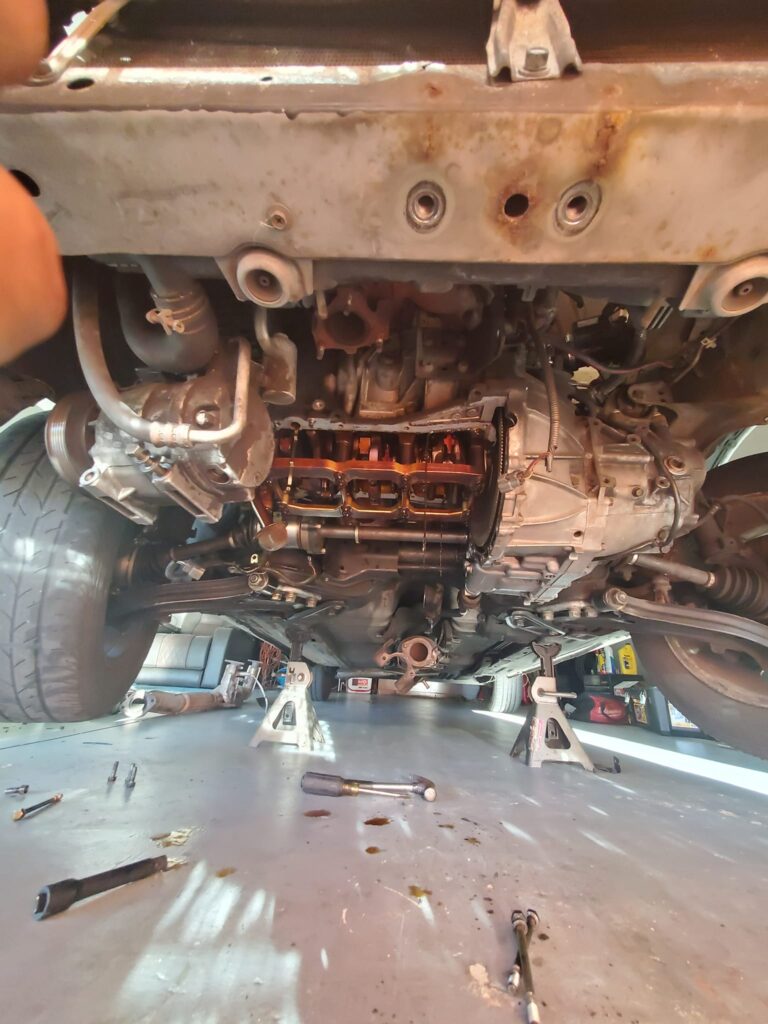
This picture shows the bolts from looking inside the oil pan area from below the engine. I removed one bolt (left) before I snapped the picture.

This picture shows the bolts from looking inside the oil pan area from below the engine. I removed one bolt (left) before I snapped the picture.

I hope this helps another VQ30DE owner in the future. If you need to remove the timing chains to remove the rear timing cover, remember to position it at Top Dead Center before you start.

The Half Moon gasket appears to be “glued” to the TC with a brown RTV looking material that is different from the gray RTC used to seal other engine components. It appears Half Moon gasket is so well bonded with the timing cover in the picture that will need to be separated with a scraper.

When you get the TC off, it is a good practice to get everything lined up on top dead center (TDC) with the gold link, the crankshaft mark, and the dowel marks. The first time I took the TC off of Max III’s first engine, I found the camshaft chain color links were opposite for each cam. It doesn’t really make a difference if you find your camshaft chains links like the picture.

The FSM goes into detail about TDC alignment.

The main point is to get everything lined up on TDC before you start working with the guides or water pump. If something goes wrong and the chain jumps a notch, you know how everything should be lined up. I like to use my own markings once I’ve found TDC so it is easier to recover if the chain jumps a notch.

My first big car project was to replace the timing chain guides on a VH45DE. That was a great experience.

One thing I learned on that project was to zip tie the chains to keep them from slipping when replacing the guides. If you think you might have some chain slack while working with the tensioner, guides, or water pump, you use a big zip tie or some mechanics wire to pull out the slack so the chain won’t jump.

Additional Reference Photos


Loading

Owner: Carlos Marinaka guapoman2000

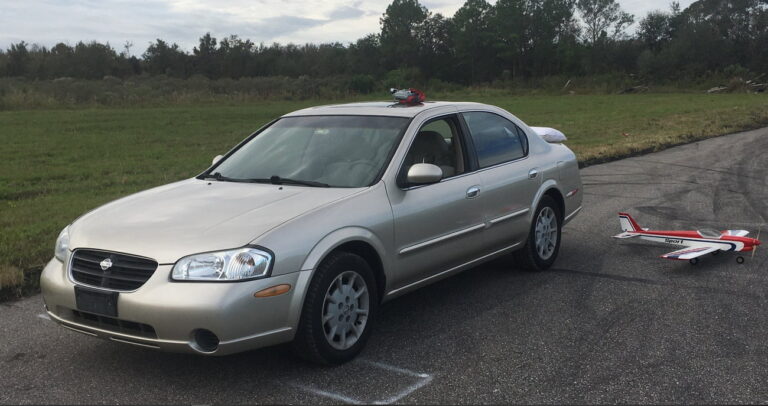
Year: 2000
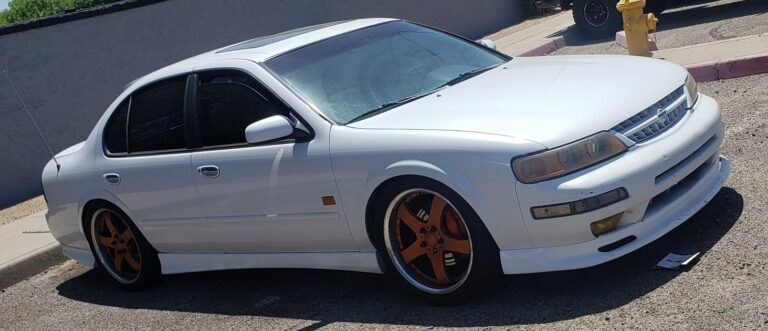
Model: Maxima
Color: Tan
Engine: VQ30DE
Transmission: 4-Speed Automatic
Trim: GLE

Notes:

  • Okay good people! Finally got my 2000 Nissan Maxima GLE back from the Pro Mechanic Shop (Ruben’s Tire, Altamonte Springs, Florida) and it has been there since September 26, 2022 and until today November 8th, 2022. Yes, 43 days but, to replace an Engine with a newer one you need lots of patience as this is a 22-year old car!
  • As you proceed in removing and placing parts here and there you realize that the “PROJECT” is better off with new parts instead of reusing the old in some circumstances and this is why it took the amount of time. Also, I insisted in Genuine Nissan Parts such as the new Thermostat, Water pump and Rear Main Seals and many other small and large gaskets.
  • The Maxima with this newer Engine (Certified to have only 130,000 miles) is performing spectacular! I can already see an improvement in Gas mileage and acceleration is exhilarating! I like to thank all at Ruben’s Tire at Altamonte Springs, Florida for having patience with me and taking great care of my car during Hurricane Ian.
  • The hard planning and work acquiring new parts paid off as it rides smooth without any rattles or vibrations! One BIG reason I decided to keep it and replace this Engine is because two years ago new suspension parts were installed such as the Front and Rear Struts, Lower Control Arms with Bushings and lateral links. New brakes all around and many more items.
  • The original Engine suffered a front main seal Blow-Out and most of the Oil left along with the Oil Pressure sending unit announcing low Oil Pressure and most recent about three months ago the Engine’s Thermostat stuck CLOSED and over-heated the Engine.
  • The original estimate was for $2,000 US for Removing the Damaged Engine and Installing a newer one from JDM Motors. I found the newer Engine from JDM Engines (Auto & Truck LLC) located in Orlando, Florida. This is mostly imported Engines from Japan (Used).However, due to my own directions about installing:
    1. New Half Moon Seals at the upper Oil Pan / Cavity.
    2. New Rear Main Seal assembly. (Genuine Nissan Part)
    3. New Water Pump. (Genuine Nissan Part)
    4. New Thermostat. (Genuine Nissan Part)
    5. New Oil Pan (lower) gasket.
    6. New Frontal Crank Seal.
    7. New Valve Cover Gaskets.
    8. Many more O-Ring Seals & Gaskets.
    9. New Radiator.
    10. Intake Manifold Gasket.


  • The grand total came to $2,635.85 which reflects a $250 discount as I played part in sourcing many parts myself and burned the gasoline to retrieve them from Auto Parts store using my Commercial Account. Oh, the certified Engine was $525 which is included in the grand total price.
  • I called around to at least three AAA certified Auto Repair shops (PRO) and two of them turned me down and the one quoted me a whopper of $5,650 large ones! You might say that for someone like me over 60-years old and no longer have my mechanic partner as he became blind, I did pretty good negotiating a super deal.
  • Again, I decided to keep the 2000 Maxima because it had previous maintenance such as complete suspension replacement up front and rear which consisted of Lower Control Arms, lateral links, Struts, Springs etc… etc…. Hope this helps.

Videos:

Loading

Credit: Tristan Friedman

Doing my upper oil pan gasket. For anyone that needs to do theirs, there’s only one pain in the ass that’s in your way. After taking the ac compressor off, the ac compressor bracket, center support, y pipe and lower oil pan, the only thing left holding the upper one on after removing all the bolts is the fkin dust cover for the axle. In the last picture you can see i had to knock it back away from the axle seal because the corner of the upper oil pan was sitting above it and ha.

Loading

Credit: Chrono

Hey guys, I just reset all my monitors yesterday on the interstate and passed the emissions test immediately after. Here’s some helpful info and background for anyone who has to go through this as I noticed there was a lot of confusion about this. First important thing: DO NOT go for an inspection/emission test if you have a check engine light and your monitors are not ready (check with scan tool), as they will not pass you and you’d have wasted your time. The first step is to fix the issue causing a check engine light if it’s on and then clear the code. In my case I replaced my O2 sensor and was good. When you clear the code the monitors will show as ‘not ready’ and you need them to show as ready. So remember for future: every time you clear your ECU with the scan tool, your monitors will become ‘not ready’ and will need to be reset – this is important to keep in mind if you have an inspection/emissions test coming up soon as you’d want adequate time to make your car ready for testing before your deadline.

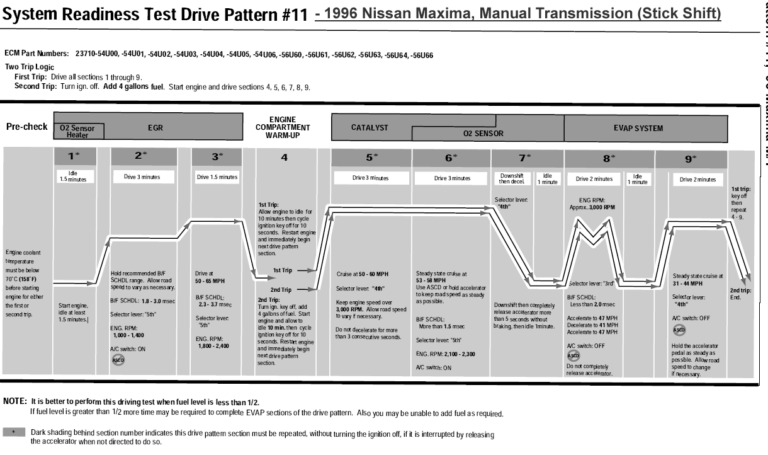
The easiest/fastest way to do this is to complete the Nissan Driving Pattern for your car which can be found here:

NTB98-018c (Found this for 96 and 97 Nissan cars, for other years check your owners manual)

SB 1996-1997 Nissan; System Readiness Test (SRT) Drive Patterns

“As part of an enhanced emissions test for Inspection & Maintenance (I/M), some States may
require the System Readiness Test (SRT) status be checked. – The SRT is used to indicate
whether the engine control module (ECM) has completed self diagnosis of major emissions
systems and components. – In these instances the State may require completion of the SRT
before permitting the emissions inspection to proceed.”

Find your Maxima by year and transmission style in that document, and follow the directions carefully. I got my monitors ready in 50 mile trip on the interstate when their were few cars on the road. BEFORE you start the drive you should use an OBD scanner to check which monitors are not ready, it may be that only 4 need to be reset so you now know to only complete portions of the drive pattern that pertain to those specific monitors, saving you time. If you don’t own a scanner I highly suggest buying one as not only will it help big time here but will let you diagnose and learn a lot about your car, plus they really don’t cost much. Ideally you want to monitor the status of all monitors in real time as you’re driving, other wise you’re driving blind not knowing which ones are ready/not ready.

Your best bet is to do the drive at a non-peak driving time on a less busy interstate. Doing this in city/suburbs will be difficult if not impossible due to constant stop lights etc that interfere with the drive pattern. Stay in the slow lane, maintain plenty of distance between cars behind and in front of you. Driving hundreds of miles to get monitors ready is not necessary, it won’t make a difference unless you follow the specific steps in the drive pattern. For example in one of the steps you have to have AC on, be on cruise control etc to make the monitor ready.

I used a bluetooth OBD Scan tool hooked up to my Droid that continuously displayed the status of all my monitors while driving (this was cool ). Once they all showed up as ready I turned around and drove to the emissions facility and passed.

Below is the drive pattern I did for my 97 SE, I annotated some important points in red that will apply to any year 4th gen (95-99). Click on it for a larger view.

Other Reference:


Loading

Credit: vbxmaxima

So there you are, happily driving your Max like I was, when the dreaded Check Engine Light came on. There is a simple procedure you can do to find out what’s wrong without having to take it to a dealer.

So there you are, happily driving your Max like I was, when the dreaded Check Engine Light came on. There is a simple procedure you can do to find out what’s wrong without having to take it to a dealer.

1. With the car parked and the engine off, pick up a flat head and phillips screwdriver.

2. The ECU is located by your gas pedal and is protected by a plastic cover.
Remove the cover by a quick twist of two screws:

You’ll find that the screw heads will pop up. Gently, but firmly pull the screws out – they’re the plastic snap-on type.

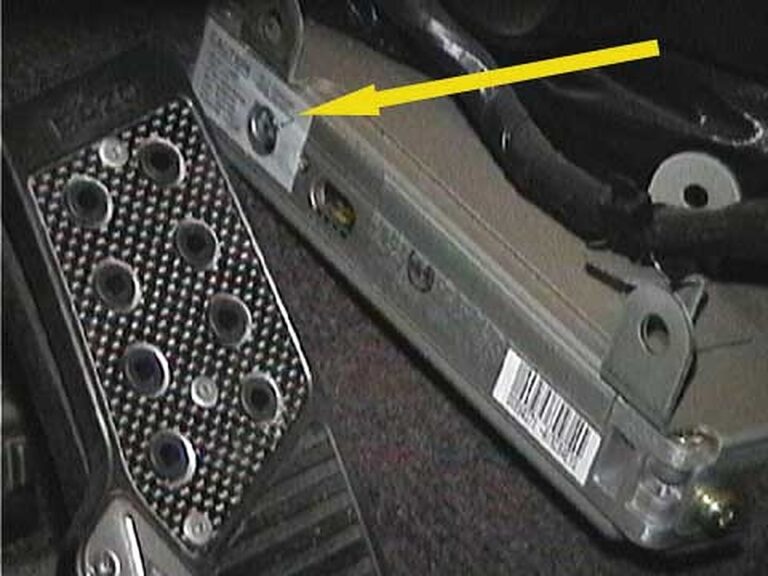
3. Remove the panel to expose the ECU. The Diagnostic Test Mode Selector is the screw indicated by the arrow.

4. Here is a close up of the screw. It is protected by a warning sticker.
You’ll have to poke through the sticker to get to the Selector screw.

If you have a hard time reading what the sticker says (like I did) here’s what it says:

DO NOT FORCE PAST STOP

AFTER PERFORMING SELF DIAGNOSIS
TURN SELECTOR FULLY COUNTER-CLOCKWISE
TO STOP

5. Put your key in the ignition. Turn your key to “ON” but don’t start the car.
Your dash lights and the check engine light will come on.

6. With a flat head screwdriver, turn the ECU selector screw clockwise until you feel it go against the stop.

7. After waiting for at least 2 seconds, turn the selector counter-clockwise until it’s stop.

8. Now watch your check engine light. It should be blinking at you. You will see a series of slow blinks or pulses, followed by a series of quick pulses. You need to count each type. If you missed it, don’t worry, it will continuously repeat. The trouble codes are 4 digit numbers. The long pulses represent the first two digits and the short pulses the last two digits.

Note: If there is more than one error code, they will be displayed in sequence.

FOR EXAMPLE:

(LONG PULSE) (LONG PULSE) (LONG PULSE) (SHORT PULSE)(SHORT PULSE)
….means trouble code 03 02

ANOTHER EXAMPLE:

(LONG PULSE)(SHORT PULSE)(SHORT PULSE)(LONG PULSE) (LONG PULSE)(SHORT PULSE)
…means you have TWO trouble codes: 01 02 and 02 01

9. Got the codes? Good! Time to find out what’s wrong. Time to use the ECU Decoder!

10. Now that you found the codes and what they mean, it’s up to you whether you want to take it to a mechanic or fix it yourself.

11. If you do fix it yourself, don’t forget to reset the check engine light! The check engine light will not go away if you don’t, even after the repairs have been made.

RESETTING THE CHECK ENGINE LIGHT

To reset the engine light is a simple procedure.

  1. Turn the selector screw clockwise to its stop.
  2. Wait 2 seconds.
  3. Return back by turning the screw counterclockwise to its stop.
  4. IMMEDIATELY REPEAT steps 1 to 3.

The next time you start your engine, the check engine light should go away!

Loading