Price: $330.00 + Shipping (Add $10.00 for new set of Gaskets) Ordering Info: To order, you can email Adam at SilverSpyder117@Gmail.com
Notes: This will not void any warranty under the Magnuson Moss act. Yes, it deletes the 3rd unmetered cat. No it does not cause any check engine lights or codes. Direct bolt on about 45 min. Install. Yes this will fit 7th and 8th gens alike. This will not fit an Altima SE-R due to the rear header connection only.
About Product & Seller:
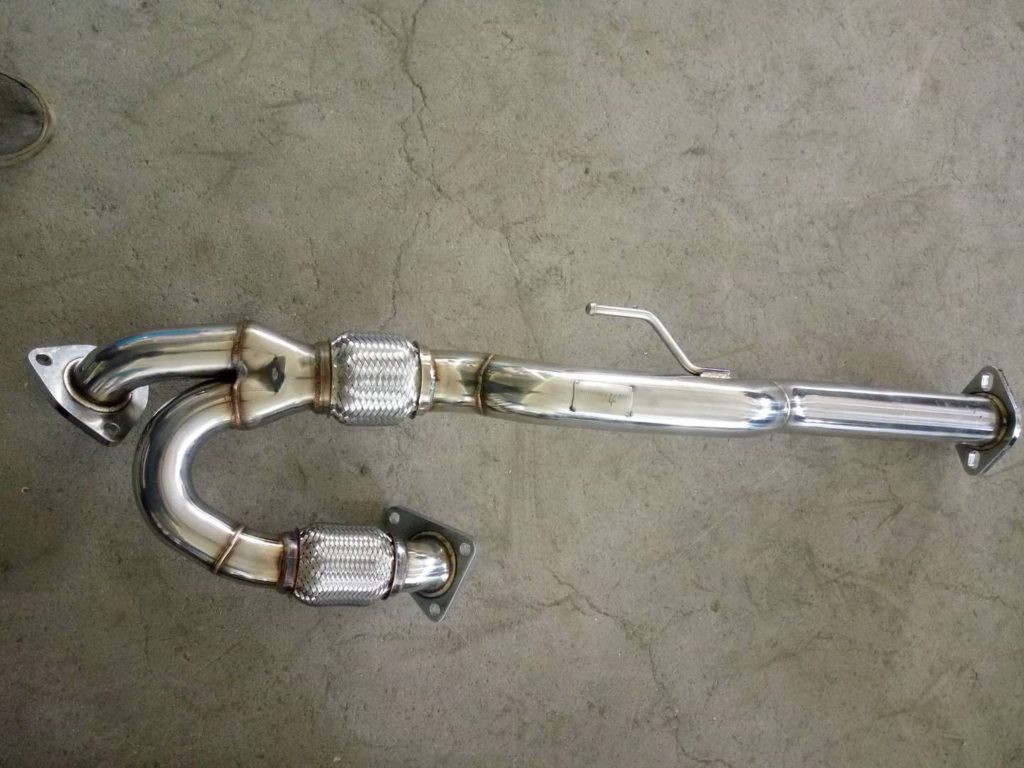
Jemini Power Performance was officially founded on 12/28/17 and named after my beautiful wife who God has blessed me with and who puts up with me dedicating my time to this community. This business and group were created for the 7th and 8th generation, Nissan Maxima. We are specializing in bringing back the well sought after performance y-pipe for the VQ35.
We took the Racingline y-pipe and revamped it to a whole new level. Racingline used bare materials such as mild steel, mild coated with aluminum, and 201 stainless steel to produce the initial y-pipe. We had it tested to see these results. Many people have seen the results of this down the road with rust and premature failure.
What we are now bringing to the Maxima community is far better. Top-quality 304 stainless steel construction throughout that will not rust, all custom made gaskets for 2 entry and 1 exit path, shortened .5 inches to meet OEM specifications and a 2 year warranty.
Everyone knows what these y-pipes do and are capable of. If you have questions please ask. From my own experience, I felt a difference immediately after install. Much smoother powerband from the CVT, no lag at all, and steady pickup. From 0 much more responsive and carries that power to well over 100+.
Alright…there seems to have been many many questions about the install of the newer OBX Headers/Y-pipe. So I have decided to do a small writeup on the installation of these headers/y-pipe. So below I have made a faq with some of my answers that should be right but if I am wrong on anything feel free to let me know…and like everything else, this is a guide to help you on your install and any questions you have, so if you screw something up it is not my fault
FAQ
1. Are these worth saving the extra money over the Cattman’s?
(Answer) If you are a do-it-yourself kind of person then yes definitely, the Cattman’s are an awesome product and have no fitment issues whatsoever (I have owned a set of Gen III’s) and the peace of mind is nice, but if you aren’t afraid to do some small modifying and saving around $500 sounds good then yes the OBX headers are for you.
2. Do these make decent power compared to the Cattman’s?
(Answer) The OBX Headers make just as much power as the Cattman’s. Depending on who you ask some will tell you they make more but I think that since the dyno’s differ I would say all around they make around the same power.
3. I have heard you have to extend the O2 sensors, is this all 4 or just the primaries?
(Answer) Alright, when I installed my headers all I had to extend was the primaries which are the O2 sensors in the collectors of the headers…now if you choose to plug up the secondary O2’s then you might have to extend them, I don’t know because I did not hook mine up.
4. Do you have to relocate the rear bung for the primary O2 sensor?
(Answer) Don’t know if you absolutely have to but I would 100%…it makes the install a lot easier and you won’t be so worried about it hitting the steering rack and whatnot. All you need to do is move the bung 90* to the right on the collector and your good to go, you could have a shop do this for you or for the DIY’r you could do it in your garage (like me…lol)
5. Will I throw a SES with these headers?
(Answer) Yes most likely, since you do not have any precats for the secondaries to monitor you will throw a code which is why it is useless to plug up the secondaries to begin with since they will still throw a code because there are no precats. The SES light thrown will not effect your performance at all because the primaries are the only O2’s that affect your A/F ratio. Now all you need is a dual output O2 simulator which you can get from here: http://www.02sim.com/ Some have reported not throwing a SES and most get one. When I installed my Cattman’s I threw one upon first startup, with the OBX’s I have been driving around for 1 1/2 months now without a simulator and have yet to throw a code, but that’s just mine.
6. Should I use the gaskets included with the headers or the OEM ones?
(Answer) Definitely use OEM multi-layer gaskets because the ones included like every other header kit are crap. Now if for whatever reason you have to use them then they are ok but plan on changing them down the road because they won’t last as long as your OEM ones.
7. Is there that much modifications to make these work?
(Answer) That depends on who your talking to. I didn’t think it was that bad. The only modifications I had to do was to move the rear bung 90* to the right, plug the 2 secondary holes in the y-pipe, trim down the crossmember like 1/2 inch for the flex section, and then grind down the rear motor mount bracket peice for the primary tube on the rear header. That’s it. Not bad at all. Some people claimed to have installed them without any modifications but I would plan on doing the above on your install.
8. Do you have to have a lift to install these headers?
(Answer) NO!!!! You can install these with your car on jackstands…I installed both my Cattman and OBX’s with the car in my garage on jackstands. Even with the one peice rear header/y-pipe deal it’s not that bad. The y-pipe header peice doesn’t weigh that much and once you get everything trimmed and out of the way it isn’t that hard to put up on the head.
That’s all the questions I could think of for now, I am working on the Install Writeup as you are reading this so I will post in a little bit, but I hope this helps out a lot with some of the questions and concerns people are having with these headers.
Installation:
Now bare with me hear as I installed these quite a while ago, so if I left something out please feel free to let me know because this is going off of memory, I didn’t take a gazillion pics either so it will mostly be an overview because I’m assuming you guys can figure out the small details . So use this as a basis to go off of when you are installing your headers, it’s not an instruction manual but I’m sure it’s a good outline to follow.
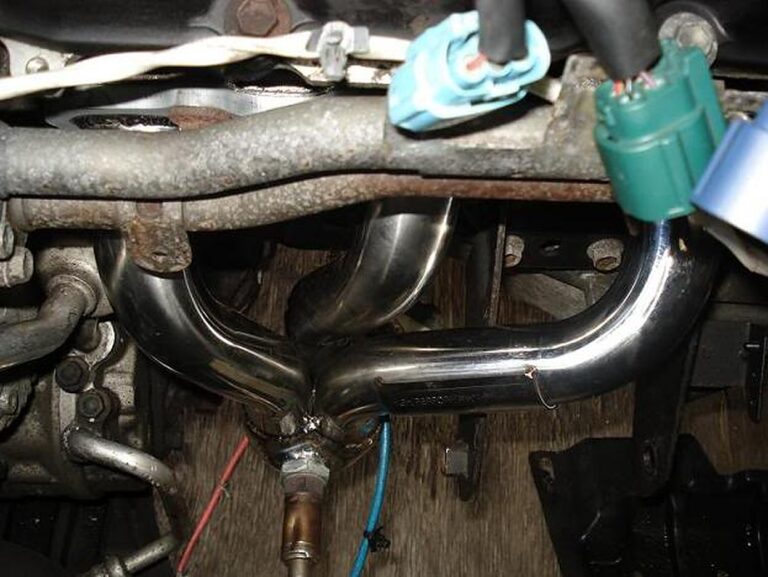
Alright first things first. Here is a pic of the bung relocation courtesy of C-Young:
1. Remove your filter, midpipe etc. off of your intake.
2. Proceed to remove your intake manifold (12mm) upper only though.
3. Remove your Radiator fans, only 2 bolts on top (10mm) and 2 on bottom (10mm) unplug them as well.
4. Jack up the car and put on jackstands.
5. Take off the passenger side splash guards.
6.Take off the front heat shield off the header.
7. Undo the 2 front O2 sensors and the rear secondary. 22mm wrench or an adjustable wrench.
8. Unbolt y-pipe completely from the precats and the cat.
9. Unbolt exhaust manifold from head.
10. Drop the front manifold throught the bottom.
NOW THE EASY PARTS OVER….LOL
11. Undo the rear O2 sensor off the rear manifold
12. Now it would be easiest to unbolt the precat from the rear manifold but mine decided to be tricky and stripped out so I couldn’t undo it so it was a little hard to get to the nuts for the header.
13. Unbolt the rear manifold using a combination of underneath the car and from on top to get to the different nuts.
14. Bolt the front header to the head.
15. Go ahead and test fit the y-pipe/header and see where you’ll need to cut (even though you already should know by now…lol)
16. Grind down the crossmember so that it’s not touching the flex section.
17. Now grind down the rear motor mount peice on top that’s almost just like a cover for the top of the mount, this can be kind of tricky, I’ve found it to almost be easier to undo the mount from the engine and cradle and take out of the car and since all you are grinding is a plate you can just cut it all the way off…photo courtesy of datdude20.
18. Your header/y-pipe should now slide up into place.
19. Bolt on header to head
20. Bolt y-pipe to cat and to front header.
21. Plug in your O2 sensors. You may need to use some zipties on the front because my wire was being hit by the fan so I ziptied it so it wouldn’t hit.
22. Double check and make sure everthing is bolted up tight so you won’t have any leaks.
**All connections should be soldered and insulated with electrical tape or heat-shrinking tubing.**
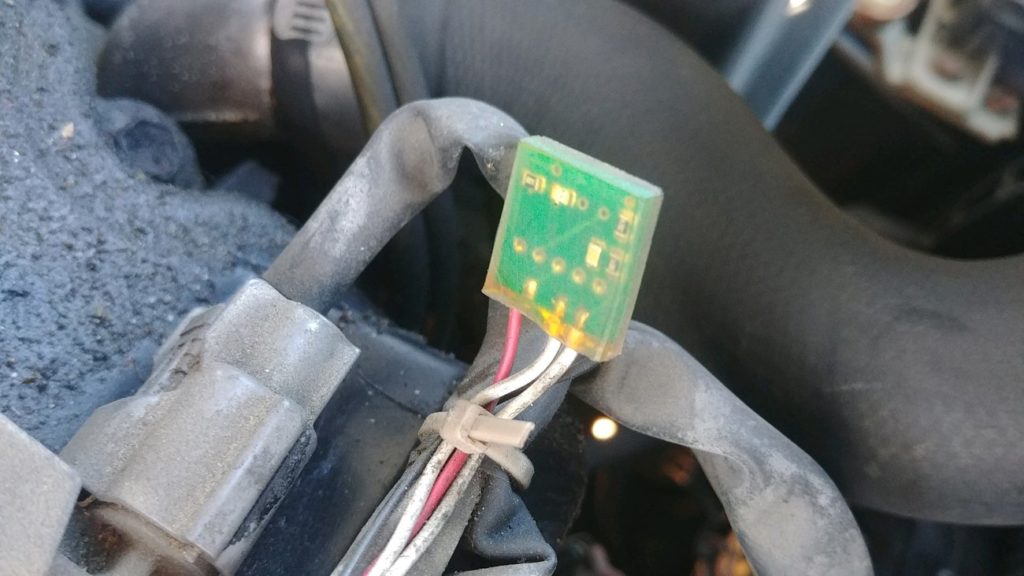
1. Find your secondary O2 sensor(s).
2. Establish which O2 sensor wires are Signal, +12 and Ground. Either use the bottom of this page for color codes of most factory oxygen sensors or use a factory service manual for reference. Chilton’s or Haynes manuals can be found at your local library and auto parts store.
3. Verify +12V wire with a voltmeter by probing the wire while the car is running.
4. Verify the Ground wire by measuring the resistance or continuity between the wire and chassis. The resistance should be very low. OR Connect the sims black wire directly to a good chassis ground.
5. Turn off the car and disconnect the Negative battery terminal.
6. Connect (splice) the O2 Simulator Black wire to O2 sensor Ground.
7. Connect (splice) O2 Simulator Red wire to O2 sensor +12V.
8. Cut the sensor’s signal wire completely.
**The side that leads to the O2 sensor should be taped off. It will not be used.**
NOTE: If you have single exhaust and/or only one secondary O2 sensor, you will only use one of the Yellow wires coming from the O2 Simulator. Cut and insulate the remaining Yellow wire.
9. Connect the O2 Simulator Yellow wire to the other half of the signal wire that leads to the ECU. If you have two secondary O2 sensors perform steps 8 and 9 with both sensors.
10. Reconnect the Negative battery terminal.
11. With the car running, the O2 Simulator LED should be slowly flashing.
Member Credit: Brandan Nankoo, Mishimoto Photo Credits: Sunday Ortiz and Gerson Flores
No one ever wants to experience the feeling of having to replace a CVT Transmission. Under warranty, it’s not so bad. But out of warranty, it will be a very expensive job. To prolong the life of the CVT, many members have been installing external transmission coolers.
You have various options when it comes to selecting a Transmission Cooler for your 2009-2015 7thgen Maxima. Two of the most popular ones are the Hayden coolers which are universal and applicable to all vehicles and then the Mishimoto coolers.
Please note that you will need an extra quart of Nissan NS-2 or equivalent.
These are very inexpensive and work very well. All rapid coolers include the patented “Flow path design” which increases heat transfer while minimizing pressure drop.
Mishimoto WRX CVT Transmission Cooler 2015+
These are much more expensive and also work well. The best way to purchase these is via a vendor who can get you a great discount.
Tools Needed
Prep for Installation
1. Jack up the front end
2. Follow Markos video on how to remove the bumper (video below)
3. Blow out Trans cooler to make sure there is no debris inside of it.
Installation (The instruction use the Hayden Cooler for reference)
1. Drill hole in plastic like in the picture below
2. Route hose through top of the crash bar in between headlight and radiator
3. Pull hose through bottom hole beside the wire that leads to crash sensor
4. Apply a bit of CVT fluid to the inlets of the cooler (this helps the hose slide on better
5. Put the clamps on the hose and attach to the cooler (tighten clamps)
6. Place the foam pads on the back of the 4 corners of the cooler (supplied with cooler)
7. Attach the bottom of the cooler with the supplied zip ties
8. Zip tie each hose with the long zip ties. Top one is tied together with the cylinder beside the ac condenser and the bottom to the wire beside it (reference pics above)
9. Cut hose in half using knife
10. Place pan under car
11. Disconnect factory cooler line from radiator which is located on the bottom just above radiator hose (factory clip needs to be squeezed with a pair of pliers)
12. Connect the line from the top of the top of the cooler to the bottom of the radiator with the new clamp
13. Disconnect the other end of the factory line (has the same style clip as the other factory one)
14. Route the other hose coming from the cooler to the end of the factory line and tighten the clamp (make sure there is no kinks in the line)
15. Double check all connections
16. Lower the car but don’t put the bumper on yet
17. Measure how much fluid came out when disconnecting the line
18. Remove CVT dipstick and add the same amount of new fluid that you measured of the old plus add approximately 150ml extra to accommodate the cooler
19. Start the car and warm up to operating temperature
20. With foot firmly on brake run through all the gears
21. Turn the car off and double check the level is in the proper range and add if needed
22. Check for leaks
23. Put bumper back on
24. Recheck all connections after 100 miles
25. Enjoy your new trans-cooler!
Additional Photos (Installation and Position of Mishimoto Cooler):




 . So use this as a basis to go off of when you are installing your headers, it’s not an instruction manual but I’m sure it’s a good outline to follow.






 4. Apply a bit of CVT fluid to the inlets of the cooler (this helps the hose slide on better
 6. Place the foam pads on the back of the 4 corners of the cooler (supplied with cooler)
 14. Route the other hose coming from the cooler to the end of the factory line and tighten the clamp (make sure there is no kinks in the line)


