

Last Updated: 09/06/2025 @ 03:39 pm
Member Credit: Streetzlegend via FastMaximas.com
In this article I will be going over all the details involved in the rear mount turbo on my 1997 Nissan Maxima.
Being the first to put a rear mount turbo on a Maxima I had to figure out a lot of things along the way. This article will answer many questions that I have been asked over the years as well as address myths that are generally mentioned. The article is organized in the same way and order that I addressed the project:
Why a Rear Mount?
One day I was watching an episode on TV where they showed an installation for a rear mount turbo on a Corvette. During the episode I started to day dream about the maxima being turbo charged and how easy it looked on TV. I reached out to a friend who had a turbo and injectors collecting dust in the garage and decided to go for it. I was a full time college student with no job so the budget was minimal and I had no resources other than a DIY mentality; this is why the rear mount was attractive. I was clueless on how turbos worked as I had never been involved or even driven a turbo car before; I started to learning all the aspects of a turbo system
How a turbo system works?
Basics
The turbo has three parts, the compressor housing, the turbine housing and the mid section. Both the compressor and turbine have wheels that are connected by a shaft which are held by the mid section. The turbine side connects to the exhaust piping from the engine and as exhaust flows from the engine it makes the turbine wheel spin. The turbine varies in size and dimensions internally and produce a back pressure in the exhaust between it and the engine. The turbine housing also has a variety of flanges with different sizes such as T4, T2 or even a V-band nowadays. This pressure forces the wheel to spin with greater force and velocity. As exhaust flows through the wheel, making it spin, it then exists out of the turbo and out to the atmosphere.
As the compressor wheel spins it pulls in fresh air, compresses the air inside the housing and then exist into piping that is connected to the engines intake manifold. Often the compressed air needs to flow through an intercooler since air becomes hot as it is compressed. The turbine and compressor both have similar designs, an inlet and outlet.
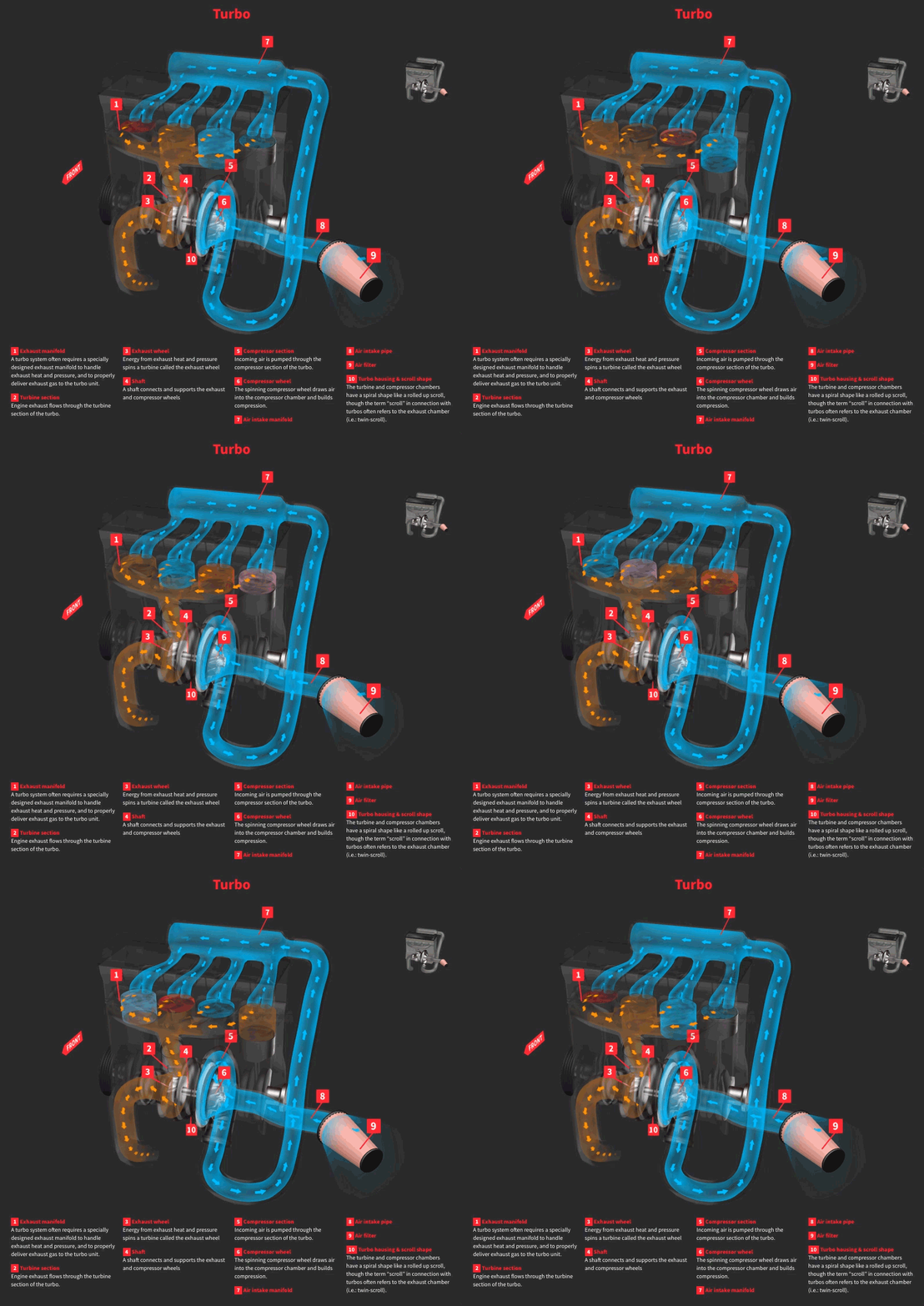
The pressure generated between the turbo and the engine is regulated with a wastegate. Think of the wastegate as a bleed valve that releases pressure in a controlled manner. By controlling the pressure thats flowing into the turbine, you are therefore controlling the pressure being generated by the compressor side that flows into the engine’s intake. The wastegate has a spring inside that keeps a valve closed preventing exhaust pressure from bleeding out. The wastegate’s body is connected to the compressor side of the turbo via a hose, this is usually called the boost/pressure reference. As pressure builds up in the compressor and pressurizes the body of the wastegate, this force pushes against the spring and starts to open the valve.
Wastegate springs vary in size and tension which is what dictates the ultimate boost pressure your turbo system generates. In addition to the spring most systems also have a boost controller. Boost controllers are another form of bleeder valve that regulate how much pressure is begin sent to the wastegate body from the compressor. The less pressure it sees the less force is applied against the spring, therefore keeping the wastegate valve from opening fully to the spring’s force. A simple way to think about it is, when the wastegate valve is fully closed, you generate all the boost the turbo is capable of producing, when the valve is fully open the turbo does not generate any pressure since its all being bled out of the wastegate.
One last piece of a turbo system is the blow off valve. The blow off valve allows for the compressed air to escapes out of the charge piping when the throttle body plate is closed. Without a blow off valve when you close the throttle, the pressure generated will need to go somewhere and therefor will push back out of the compressor wheel. In the long run this can cause damage to the turbo’s bearings and in balance in the shafts spin. So as you build boost, you let off, the air pressure escapes; this is the sound you hear in most turbo cars. Often times there are recirculating valves where the released air is sent back into the inlet of the turbo but I wont get into those details here for simplicity.
Turbo lubrication and cooling
The shaft of the turbo is suspended in the middle by bearings, they can be journal or ball bearing. A journal bearing is when a shaft rotates in a surface that contains oil; the oil keeps the shaft from coming in contact with the surface it sits on. Ball bearing is like a the bearings on a skateboard and requires less oil. There are other technologies such as oilless turbos and different ball bearing materials to but these are the basics and as far as I needed to understand.
When using a journal bearing the volume and pressure of oil applied to the turbo is important and checking with the turbo’s manufacture is always recommended to see what the required volume and pressure is. Ball bearings require less oil so a smaller restrictor is needed than a journal bearing, some journal bearings are said to not require any restrictor but I have never come across this with the VQ; we always need one from my experience.
Another function of the oil is to cool the turbo’s center section; some turbos are also water cooled where they connect to the cooling system of the engine.
The Rear Mount Turbo
Now that we know how a turbo works lets get into the details pertaining to the actual rear mount turbo configuration.
After laying under the car for some times and brainstorming where the turbo should fit best I decided to locate it where the muffler is. I unbolted the muffler and cut off right after the rear beam, then had a local muffler shop weld a T4 flange using the turbo to mock up. Once I was home, I then bolted up the turbo.
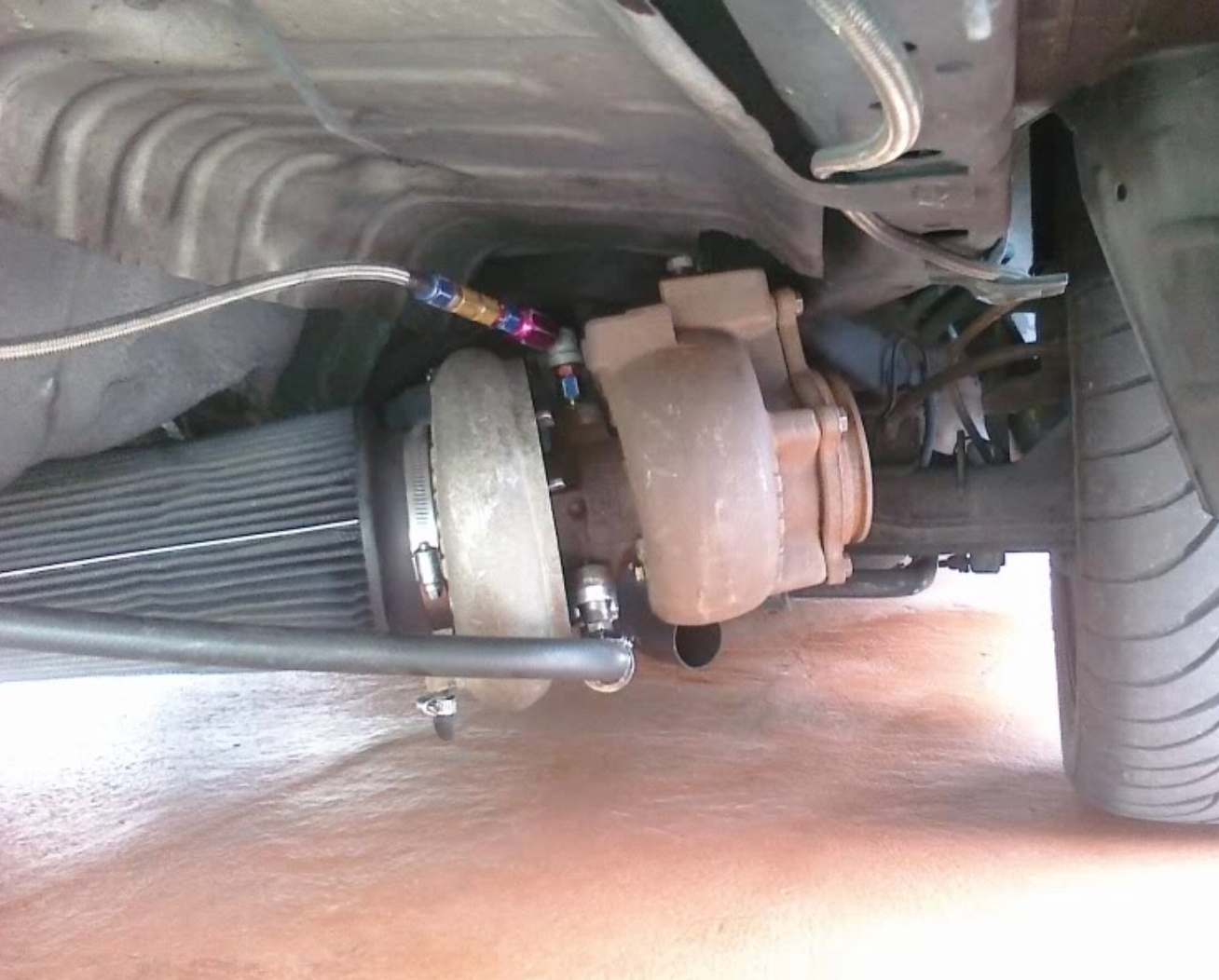
The turbo air filter I used was a large 4inch open K&N. I had to hammer in the spare tire well so that the filter could fit however that is not necessary as there are filters that have a much lower profile. I had a few ideas for locating the filter including having it inside the truck, or routing it to the driver side. I tested putting the filter in the trunk while having an additional hole for fresh air to come in. The hole I made for the fresh air to come in was not large enough so with the windows closed when the turbo would go into full boost you could feel the negative pressure in the cabin; not good. At the end I kept the filter like shown in the picture for years and never did I have issues with water. This car was driven daily in Miami where it is raining often.
Oiling the turbo in the back.
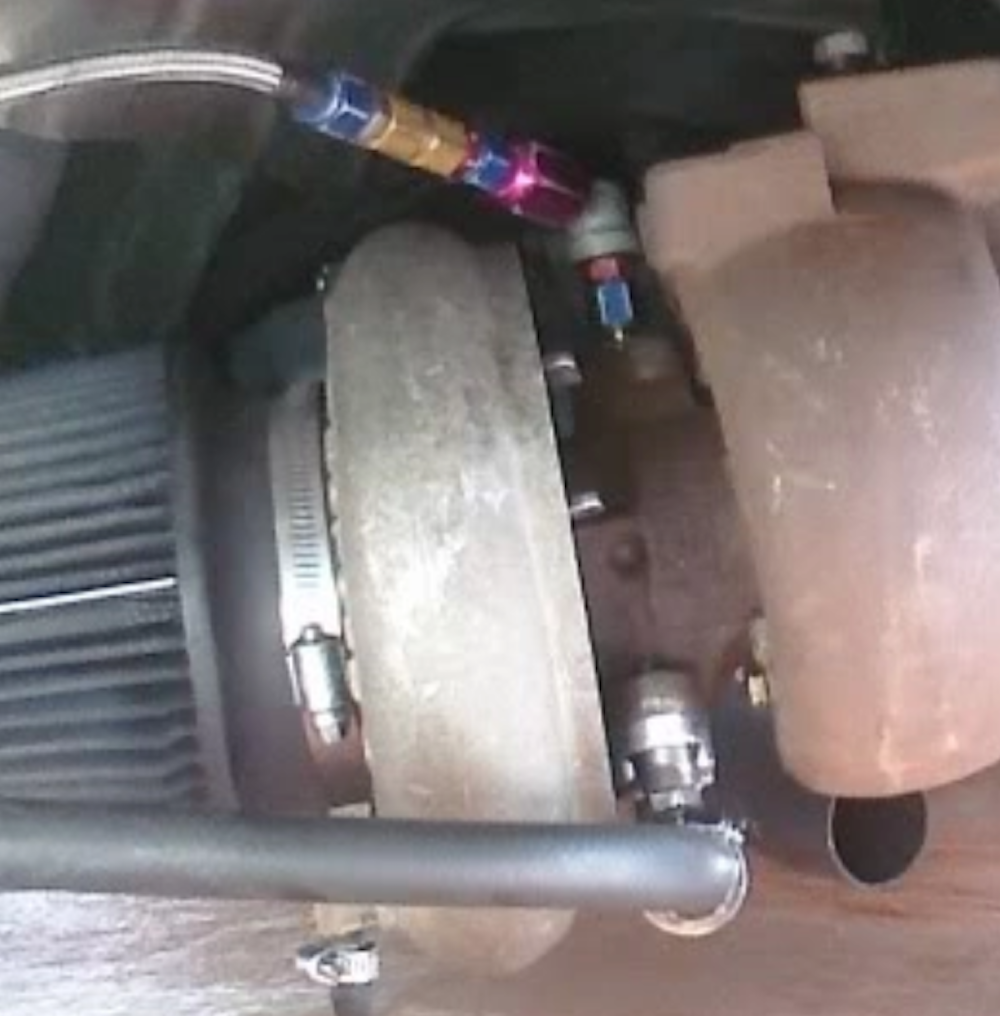
I purchased a generic eBay sandwich plate that has 4an ports, added a 4an fitting and then connected a nitrous line (what I had at the time). I routed the line on the passenger side of the bottom of the car using zip ties to hold in place.
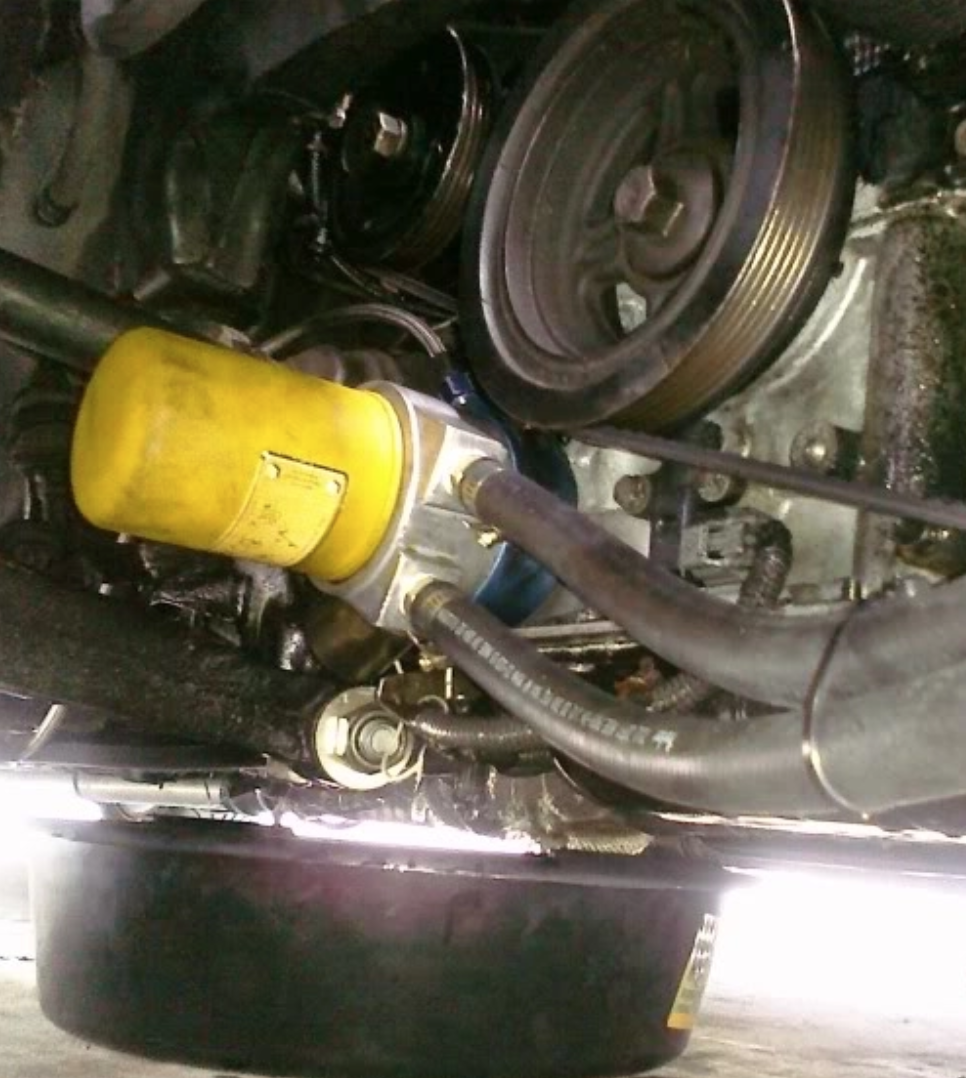
On a traditional front mount turbo setup the oil feeds the same way, but the drain or outlet of the oil from the turbo goes back into the engine via gravity; most front mount turbo’s are located above the engines upper oil pan. Since I did not have this possibility I needed to figure out how to get the oil from the turbo back to the engine.
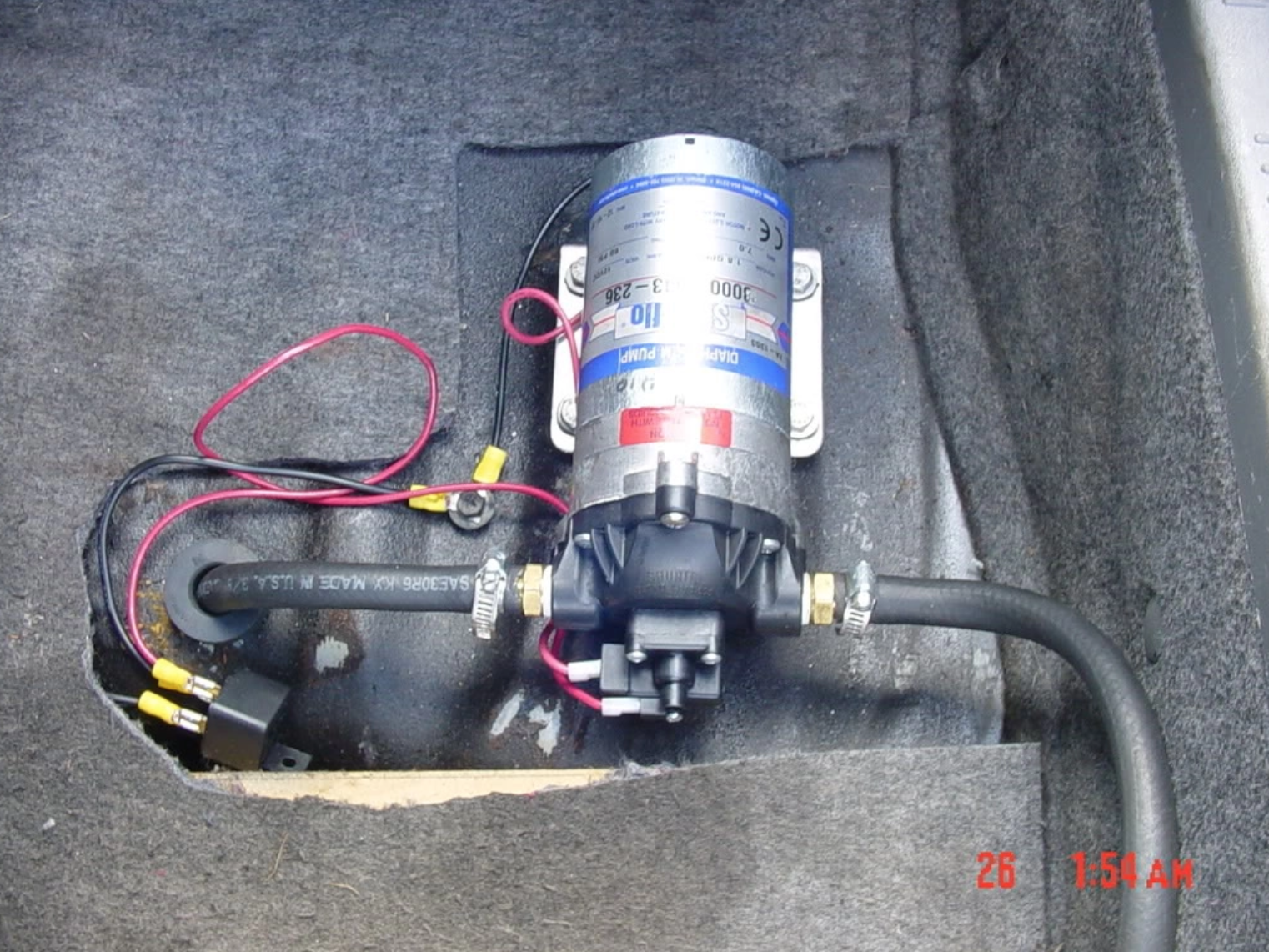
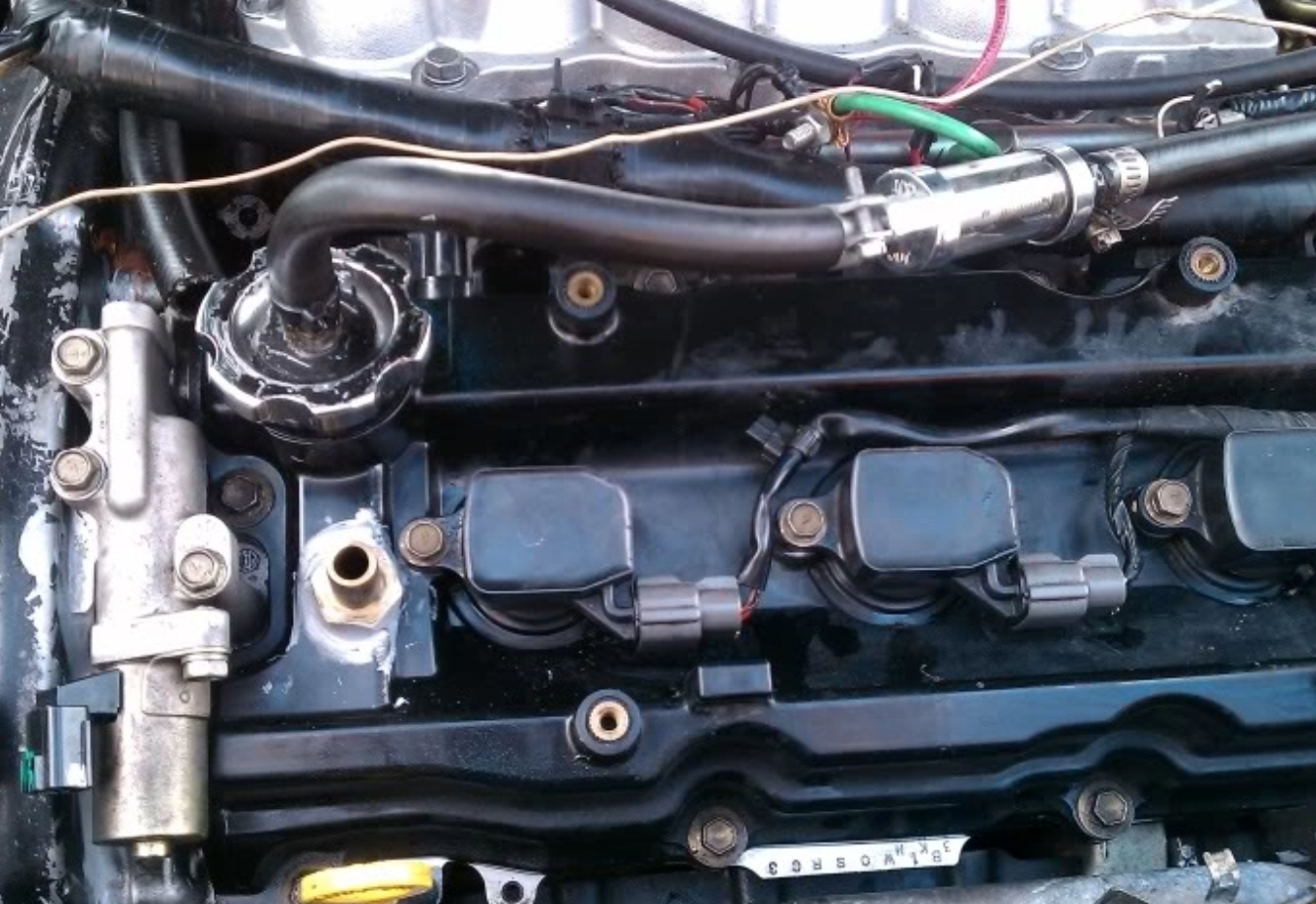
My solution was using a Shurflo 8000 series scavenge pump that is generally used for water, such as in RV’s for sinks or other uses. I decided to use this after having long conversations with someone in the Cavalier Z24 community that was also working on a rear mount turbo. I used an 8an line that connected from the turbo, into the trunk (by the spare tire well) and into the pump. The pump outlet had a 3/8th hose that came out of the trunk by the driver side of the car, over the rear beam and to the front of the car beside the fuel line. At the front of the car the line then came up over the transmission toward the front valve cover and then to the oil cap. I bought a metal oil cap then I drilled, tapped and screwed in a 3/8th barb which is where I connected the hose. I also had a clear glass inline fuel filter without the insides so that I can observe the oil flow for testing and diagnosis.
Oil problems
Oiling was the most challenging part of this project because I had to deal with regulating the flow going to the turbo in coordination with how well the pump removed oil from it. If you feed it too much oil, the pump may not be able to pull it fast enough so then the oil builds up pressure in the mid section and leaks out of the turbine housings. I quickly learned that blue smoke on vehicles usually means that oil is being burnt (white smoke being coolant, black smoke being fuel).
Part solution was using an oil restrictor. These restrictors are sold specifically for turbos but being on a budget I had to work with what I had, and that was using nitrous parts. For the Garrett T04b, I used 4an fitting, cut off the flared part that connects to the hose and put a nitrous jet in its place where I then drilled a 1/16th hole; this gives you an orifice size of 0.063.
This helped stopped the turbo from smoking and i was finally able to drive around with it but there were more complications.
I noticed that when the car was at a stop and then I started her up, smoke would come out again. The reason was that while the car was turned off, the feed line to the turbo continued to drip oil into the turbos mid section and then leaked into the housings. I fixed this by putting a check valve that required 1psi of pressure to allow fluid to pass, with the car off it no longer leaked.
Another issue was that even with the pressure check valve in place it would smoke. The reason for this was because the pump was wired into the ignition. So when you turn off the car, the pump does not have time to pull all the oil collected in the line and turbo; this causes it to leak into the housings. The solution was to leave the pump running on a turbo timer for a few seconds to clear out the line. I used a generic eBay turbo timer for this.
The last problem I had was when doing long highway runs where the engine was at high RPM’s for an extended period of time (for example a 1/4 run) the pump was not able to keep up with the oil delivery. I ended up adding a second pump using a T on the line for pulling from the turbo and another T on the line that went to the front of the car. This was the last step needed to not have any oil issues again. This process was all through discovery by trial and error so doing this again would be very simple.
Turbo Charge Pipe
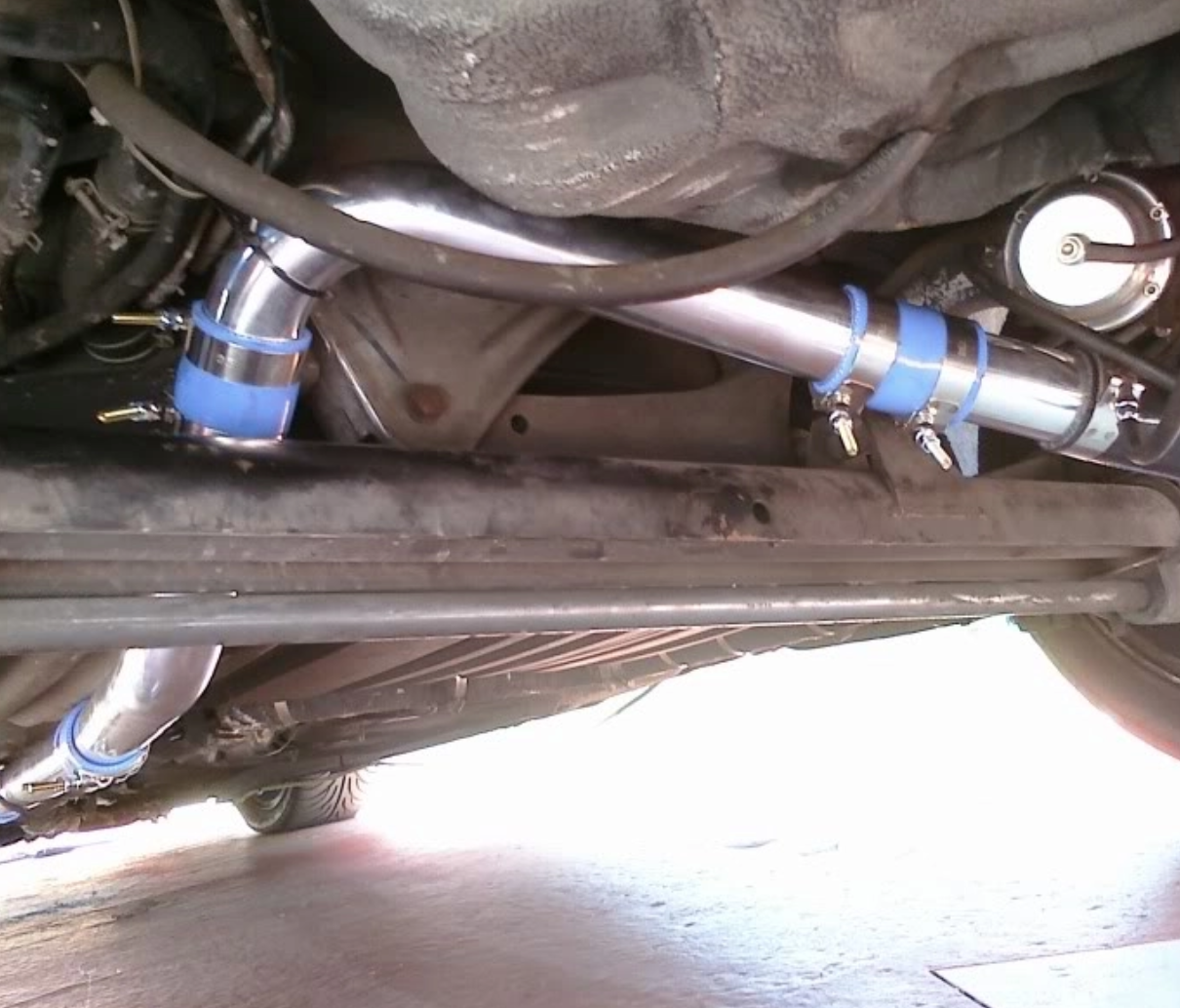
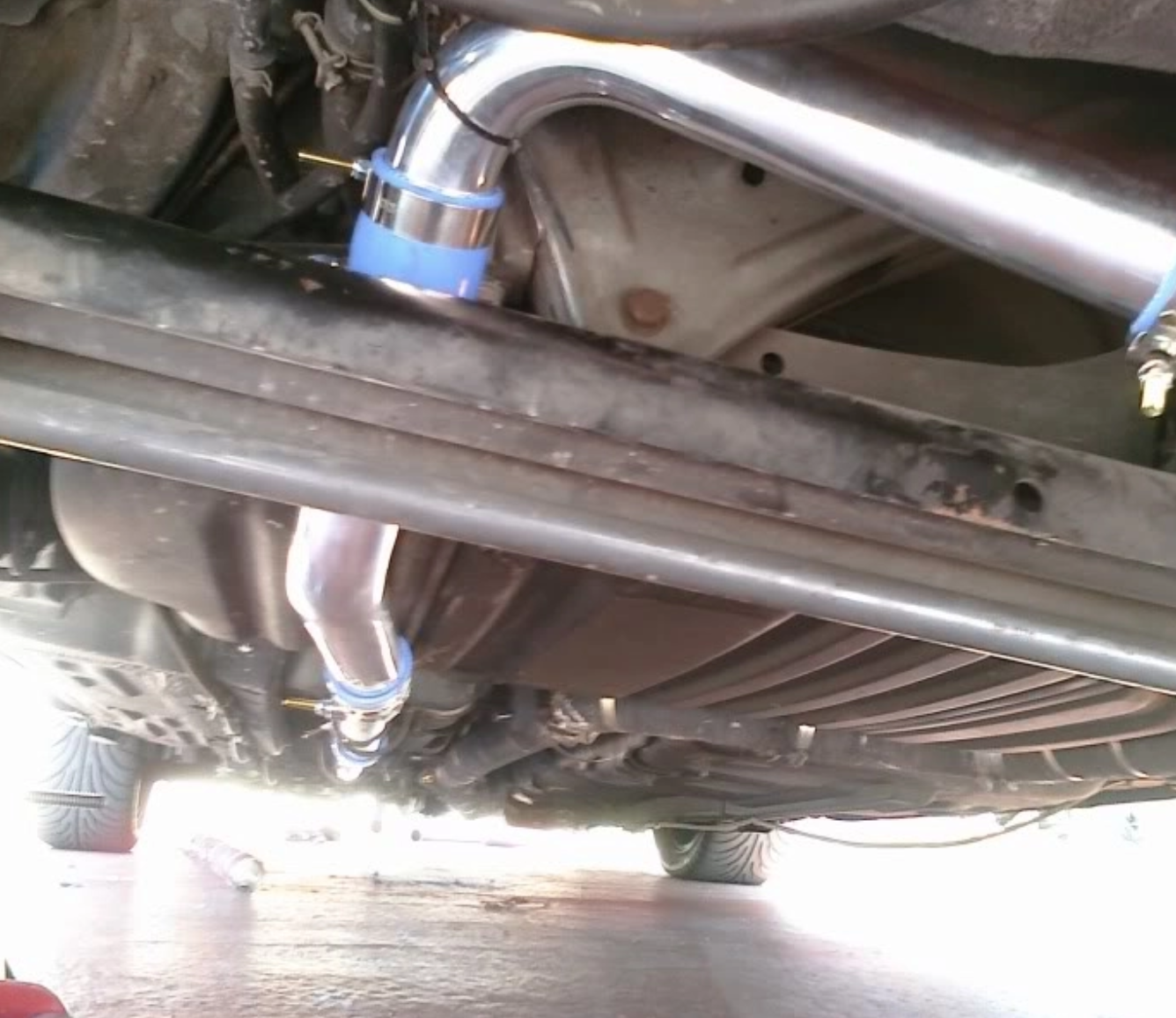
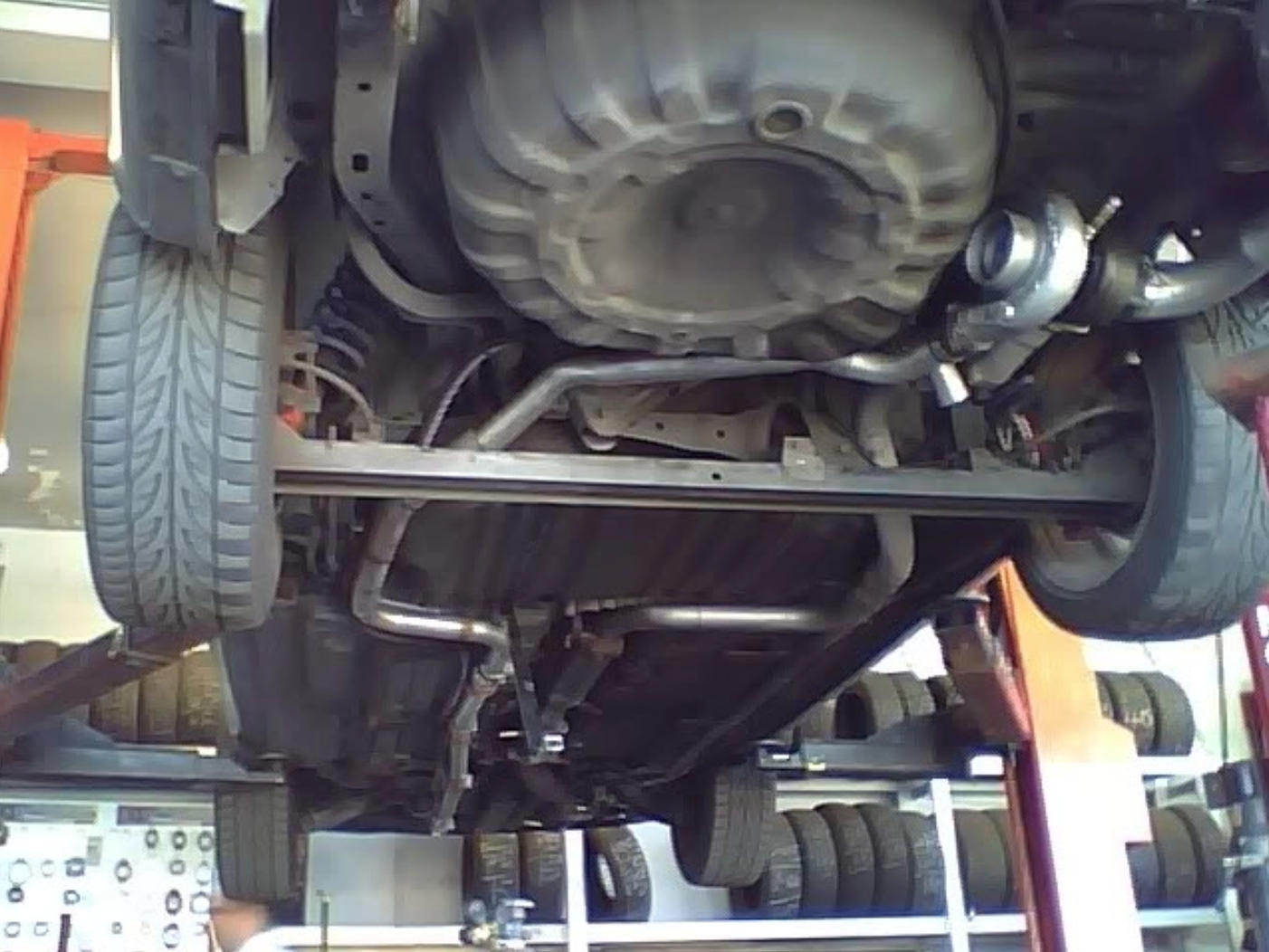
Initially the turbo charge pipe size used was 2 inches. It was out of steel as it was the quickest and cheapest option available for me. For bends I used heater hoses and worm gear clamps. I routed the pipe from the turbo to a 90 degree turn towards the drive side, then a U bend over the beam and towards the bottom of the gas tank. From the gas tank I ran a straight pipe beside the fuel lines and oil line to under the transmission, then a 90 degree turn up where the blow off valve was placed, then another 90 degree turn that routed towards the intake manifold. This initial setup was without an intercooler and the initial boost pressure I went with was 6psi.
Intercooler
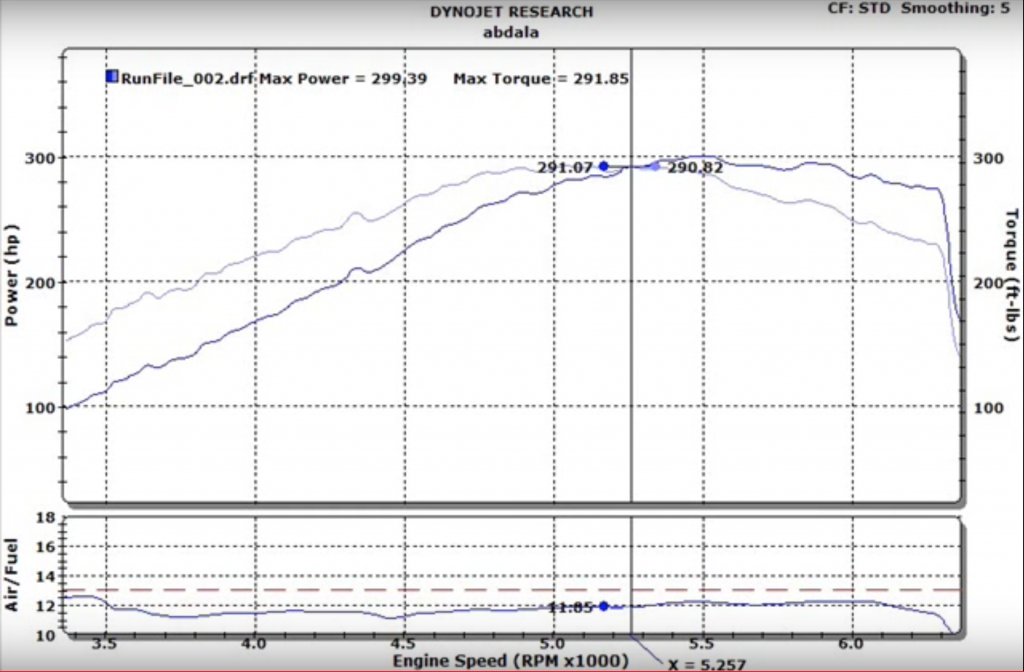
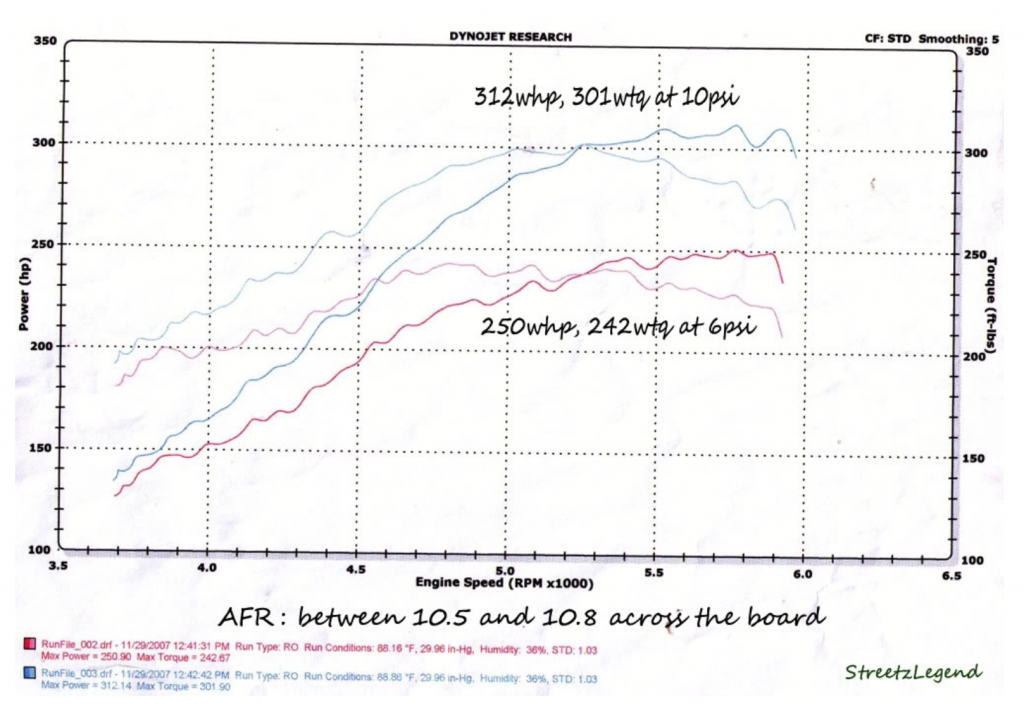
At first, I did not use an intercooler for simplicity. Eventually I purchased a methanol and water injection kit (there will be another article about this) because I quickly started to pick up engine knock. There is this common misconception that by having a turbo mounted in the rear, you no longer need an intercooler; this my friends is completely false. I was able to push the system without an intercooler up to about 10psi with the methanol and water injection. Without the intercooler at 10psi I achieved 299whp and 291wtq, at 6psi it made 250whp and 242wtq.
I routed the charge pipe from the turbo by going under the transmission, then a bend that turned towards the passenger and between the radiator and the front engine mount. Then the pipe continued to near the fog light area where it turned towards the radiator support and through it (after drilling a hole through the support). Then a bend into the intercooler and on the driver side the pipe exited and turned into the support back towards the engine bay. Then the pipe turns upwards with the blow off valve in place behind the fans and then towards the MAF and throttle body.
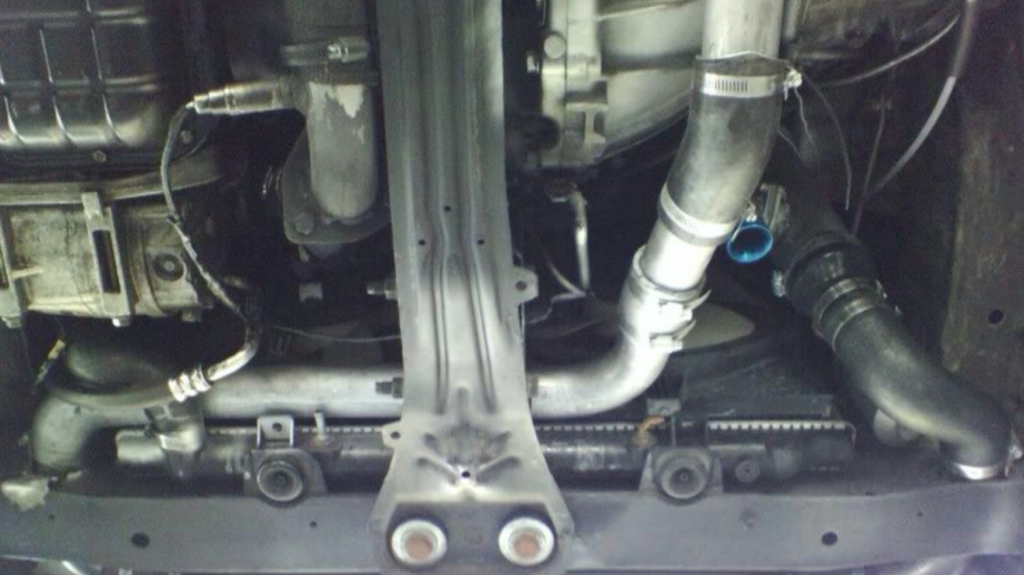
I then upgraded to an intercooler with the size of 28X5.5X2.5 and the inlet/outlet were 2 inch. My temperatures before the intercooler on average were 130’s F during boost. After the intercooler installation the highest temperature I saw was 111 F. This was on typical Miami summer weather so likely in the low 90s or 80s.
With the intercooler, I at the same 10psi it made 312whp and 301wtq.
Upgrading to 2.5 inch Charge pipe
Over time I felt that the 2 inch charge piping was a limitation, so I purchased an intercooler piping kit from eBay for 2.5 inch diameter. I then pressed them into an oval with 2/4 pieces of wood and a mallet. This was the pipes that went directly under the car between the gas tank and the engine.
The performance gains from upgrading to 2.5 inch was drastic in all aspects. Spool up was faster, the mid and top end of the RPM performance were significantly improved. The 2 inch piping which I believed would have improved spool up due to more velocity was actually a big restriction. I recommend starting off with a 2.5 inch charge pipe from the beginning.
Exhaust Piping and Spool Up
From the engine to the turbo I already had a 2.5 inch y-pipe and a 2.5 inch cat back. One of the most important parts of the whole system as far turbo performance and response goes was to wrap the entire exhaust with header wrap. I wrapped the y-pipe and the cat back; this improved the spool up of the turbo. The next improvement was removing a 22 inch Magnaflow resonator. I found that even though the resonator was completely straight through, it slowed spooled up by a lot. This could be because the resonator could have been functioning as a heat sink absorbing a lot of heat and therefore slowing down the velocity of the exhaust. With the piping wrapped and no resonator the turbo responded just like it would on a front mount, at the time I had no way of logging so I did not record data for this, but it was a significant improvement.
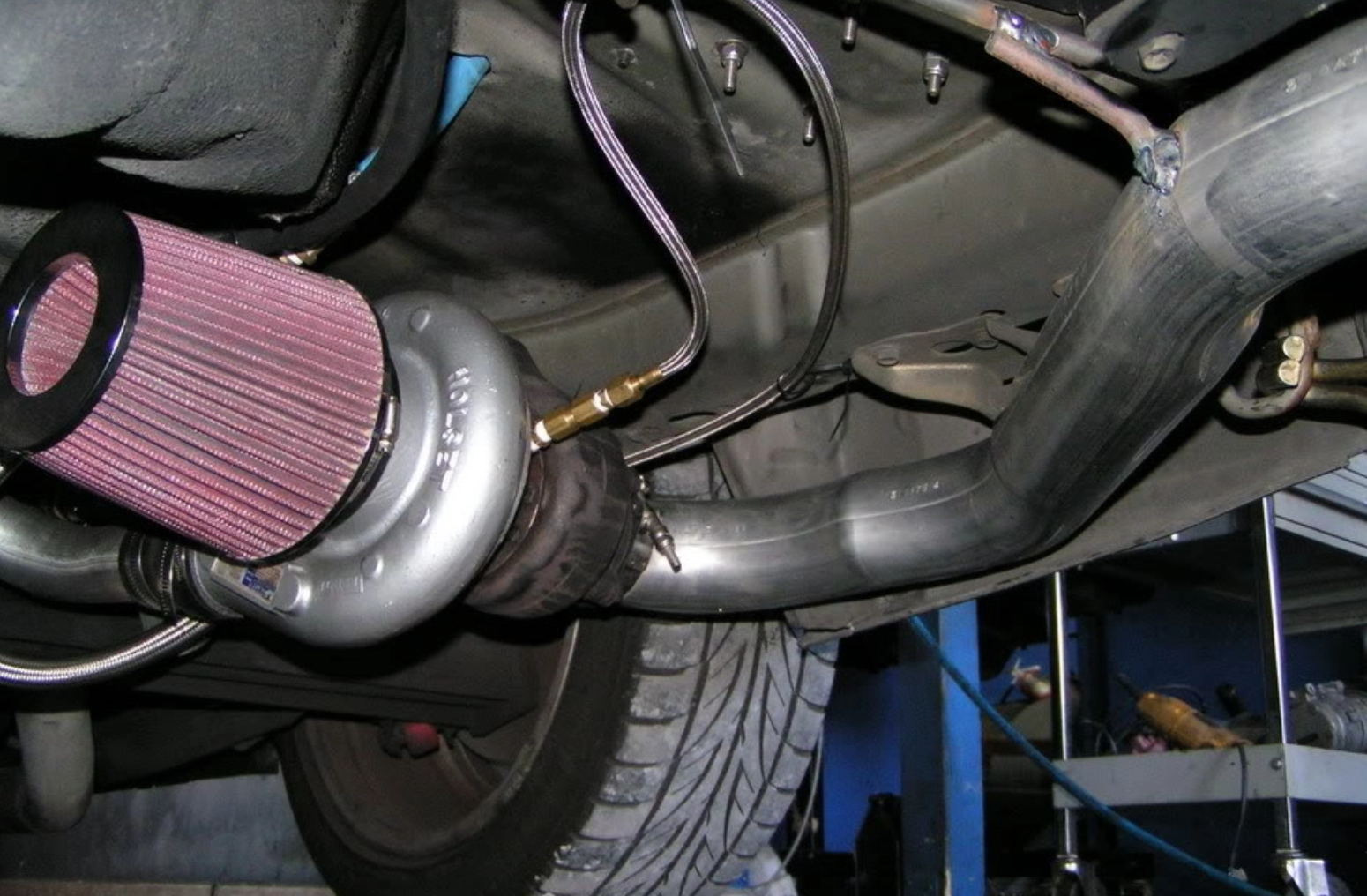
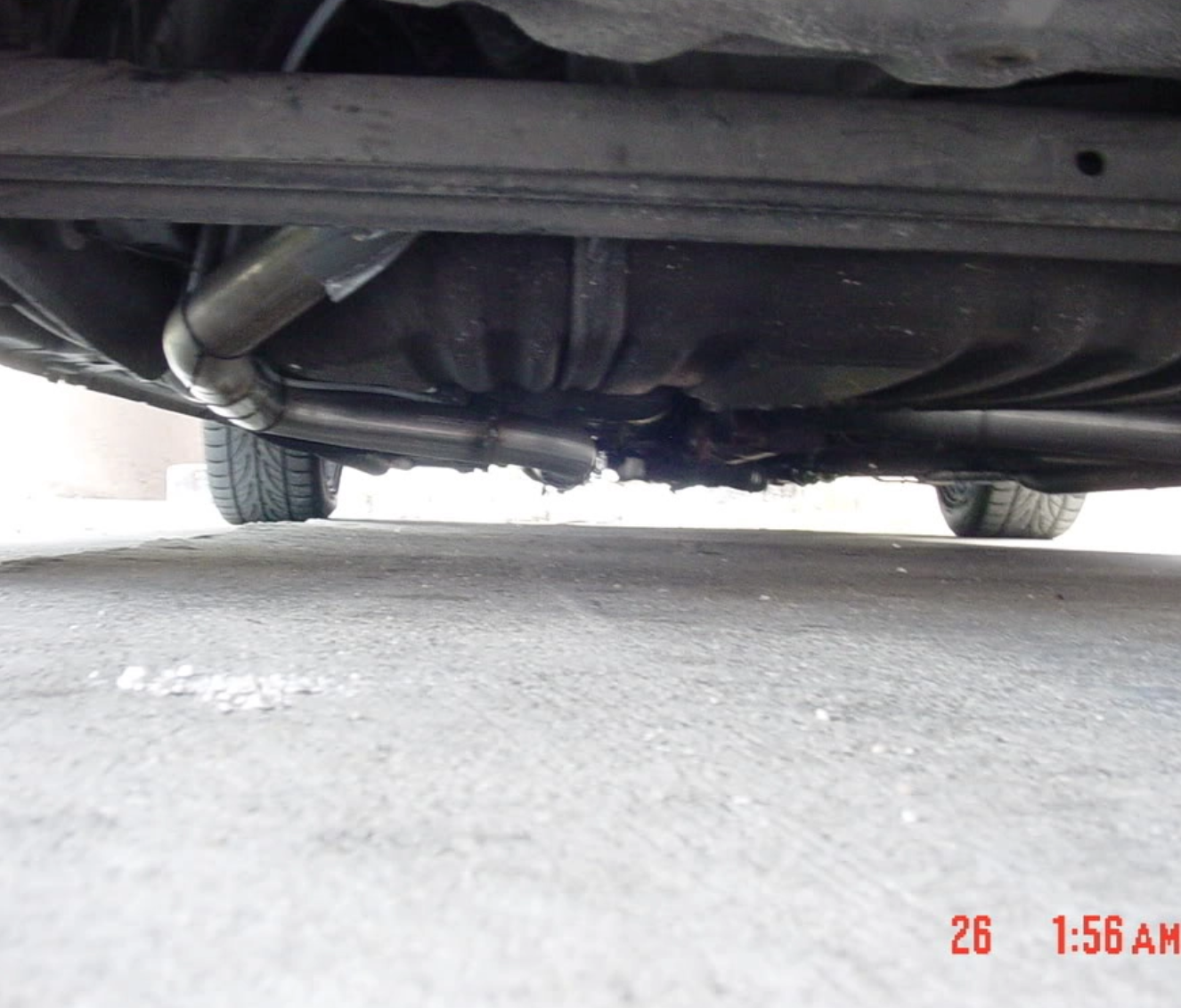
I then had the muffler shop route a straight pipe from the turbo to the factory muffler tip location. This picture below shows another rear mount turbo maxima where the same straight pipe was done.
The next step was to figure out what to do about the sound, it was very loud and being automatic it did not make for a good daily driver like this. I went to the local muffler shop where they put on a bend out of the turbo near the tire, then into a muffler. At first the bend was crushed style but we all know this is not acceptable so eventually I upgraded to a mandrel bent outlet.
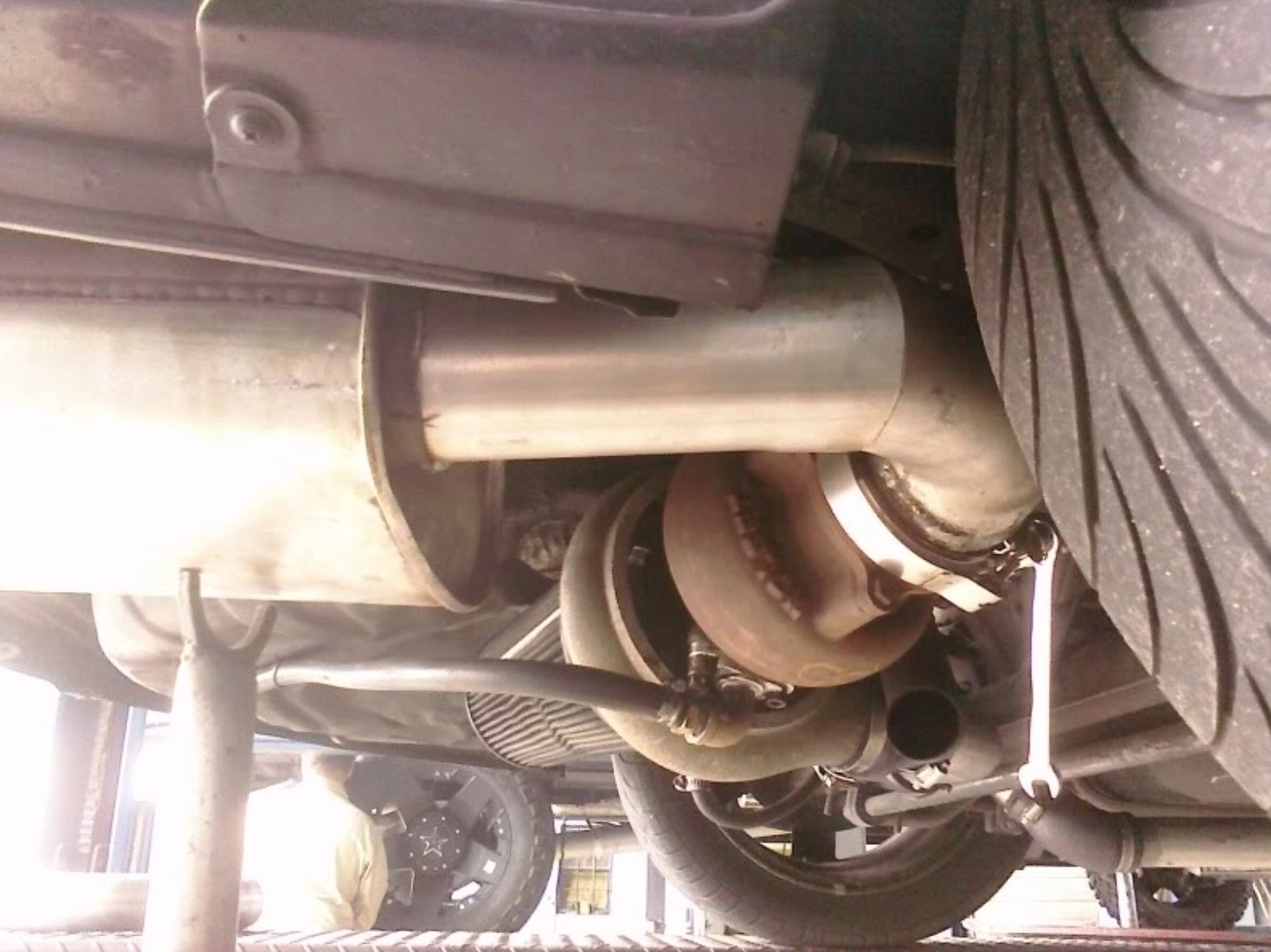
I now had a turbo rear mount maxima that was quiet and performed really well. I drove this car for years with this setup and raced it a lot. Here are additional photos showing how one can route the piping on the 4th gen Maxima.
First 1/4 Track Time as a Rear Mount Turbo
With the TO4B turbo, boosting 7.5psi non-intercooled, a 2000-2001 Maxima intake manifold, and an APEXI VAFC2 for tuning the fuel, this is what the car ran in the 1/4 mile.
R/T… .147
60’… 2.364
1/8… 9.304
mph… 81.67
1/4… 14.143
mph… 102.89
My previous best time was with the 75 nitrous shot and I ran a 14.2@98mph with a 2.3 60′. The turbo at 7.5psi was putting down more power than the 75shot.
In the next article I will continue to discuss the rear mount. I will write about a different solution for the oil system among more details regarding the rear mount. Thank you for reading and feel free to comment or ask questions that were not covered so far.
Rear Mount Turbo VQ35 Swap
After racing the VQ30 a lot I eventually needed to replace the head gasket. Since this was my first experience tuning a car, the engine spent a lot of time knocking initially. I wrote an article about my tuning experience here. Over time I noticed that at 10psi the coolant reservoir would over fill, this meant that the head gasket was starting to fail. I then replaced the gasket and continued pushing the VQ30 passed 10psi. The engine started to also develop additional blow-by because the rings were not sealing properly. I believe these failures were due to my tuning experience, I am not upset nor do I regret this as this was part of the learning experience for tuning a turbo car.
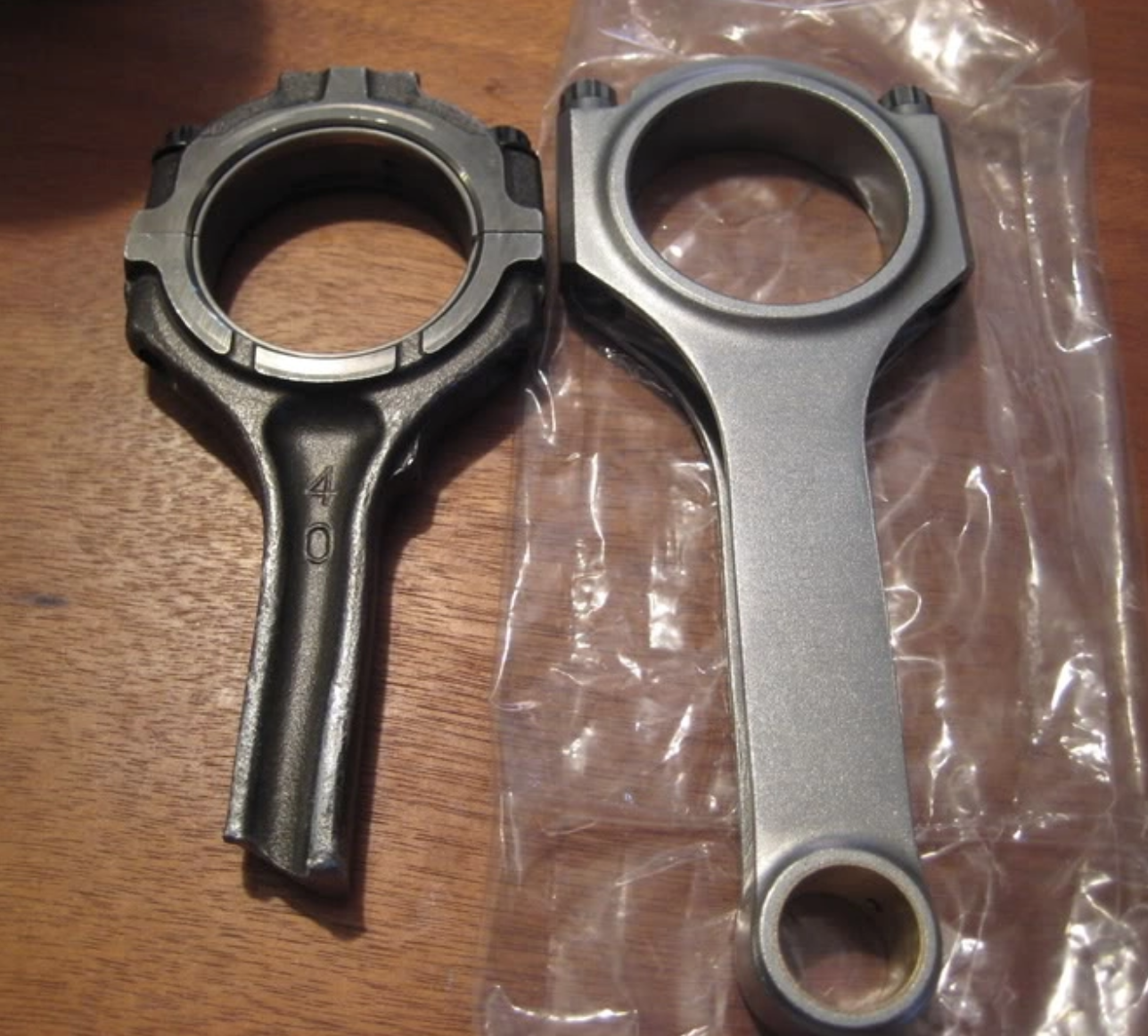
I then did the VQ35 swap while using the 3.0 timing equipment. The engine I used was from the junk yard and only lasted about two weeks before a rod broke. When I finished the swap I always noticed a feint tapping sound and VQ’s being noisy engines I somewhat ignored it but still acknowledged it (maybe I was in denial). Then while cruising down the highway without putting it through any abuse the tapping turned into a loud knock which eventually went silent. The moment it went silent I knew something was about to happen and then BAM, a rod broke. This is why I will never trust a junk yard VQ engine, specially since we are seeing blow VQ35’s being a trend now when put under some significant boost. My decision was to build the bottom end of the VQ35.I will write an article about it because it was a fun journey where I learned a lot and I know many of you will find it valuable.
Most of the videos I have as well as races at the track as a rear mount turbo were all with the built VQ35.
Turbo Compressor Surge
Something I experienced was what they call surge (flutter, among many other names). That is when you let off the gas, the throttle closes, and the pressure does not escape out of the charge pipe fast enough causing the pressure to back up into the turbo compressor wheel. The sound produced to some may be cool, but it is not good for the turbo, some turbos are designed to handle this but its better to not have this at all. This cause throw off the balance of the wheel and shaft. The blow off valve that I had was not able to vent enough so when I would let off you could hear the flutter (sh sh sh sh sh sh). I am not going to lie, I loved the sound. What I did was add a second blow off valve to the back near the turbo, then a hard line coming from the valve to the intake manifold. Now when I let off the gas, both blow off valves open venting the charge pipe immediately.
I also learned that it was important for the blow off valves to have a good source of vacuum, and having a line that would not flex or collapse. This way the response and volume pulling the valve open would be greater. A thin line with vacuum is far weaker than a large line with vacuum.
Self contained oil system for the rear mount
One thought I had was to have a self contained oil system for the turbo. This is when the turbo oil is fed from a tank through a pump. The pump pulls oil from a tank, sends it to the turbo, the turbo then drains the oil back into the tank. I spent a lot of time thinking and planning this out but at the end of the day, it was not worth the effort. You have to take care of cooling the oil because with every pass it gets through the turbo it is heated. You also had to possibly vent the tank.
Now the tank or container can be below the turbo so that the drain naturally flows into it, but being a rear mount turbo means that the turbo is already pretty low unless you have it way up in the bottom of the car. This means you would need two pumps, one to pull oil from the turbo and feed it into the tank, and another to send the oil back to the turbo. Now you have to take care of the pressure being sent to the pump and regulate it. All this was too much trouble to really have little benefit in my opinion. Having a line from the engine to the turbo, then a line from the scavenge pump to the engine was far simpler and effective; possibly even cooling the oil on the way back (although I didn’t do it with this intent).
What are the costs involved?
A turbo can be had for any price to be honest. I started off with a hand me down which was a T04b T4 .69ar turbine turbo. Then I got a genuine Holset HX35 for less than $300, and eventually ended up with a Holset HX40Pro Replica for also less than $300. I put a lot of miles through these turbos, over 100k miles on the first engine build and the only issue they had was due to user error when I made a mistake that caused the oil feed to be restricted, running the turbo dry. Here is what that sounded like:
And this was the damage:
I mention this failure in this section because once you turbocharge a car, you will have issues come up, specially if it is the first turbo system you have worked with. So yes you can have an initial parts list all priced out but you also have to think about what could come up later on. Now lets get into the parts list.
Parts List
The parts list would be the same as a front mount turbo.
- Turbo ($300-$2000)
- Wastegate ($250-350): I did not want to go cheap on the wastegate as it is an important piece, I got a Tial 38mm.
- Blow off valve ($25-$200): this I did go cheap with and I used an Turbo XS RFL which was very loud and fun to have, however by design they leak since they do not have a diaphragm, its a metal piston that does not seal completely.
- Scavenge Pump ($100-$200): I used a Shurflo 800 series pump, two of them. A gear driven pump is said to be better for this occasions, those go for about $400-$600 at the time I was looking. ebay has them nowadays for less than $100 but I have no experience with them.
- Intercooler ($100-$300): I started off with an eBay intercooler, then upgraded to a better quality one.
- Oil Sandwich Plate ($10-$30)
- Stainless Steel Braided Oil line ($20-50): I used a 4an nitrous line.
- 3/8th oil line (transmission line works): This line is for returning oil to the engine as well as pulling from the turbo and into the pump.
- Charge pipe ($80-200), that can vary greatly depending on how you go about routing and material.
- The rest is miscellaneous parts and labor such as welding, flanges, gaskets, etc…
Turbo sizing specific to the rear mount
After using the T04b turbo, I then moved to a Holset HX35 turbo. I did research on the Holset’s and saw that one of my favorite platforms (the DSM’s) used them a lot. I got on eBay and came across a brand new genuine unit for about $235, I had to get it.
The HX35’s are ideal for mid 300whp, once I wanted to make more power I went for an HX40Pro. The Pro means it has a larger more efficient compressor wheel that helps produce more power. These turbos come with a large turbine housing with over 1. AR (18cm^2). They do not spool very fast but work great overall. I saw that the DSM community likes to put a T3 .70AR Bullseye turbine, now this my friends really transformed the performance of the car; the turbo spooled immediately.
This is how the turbo performed with the large Holset 18cm housing before the Bullseye housing.
This was my reaction on the maxima forum after putting the Bullseye .70ar housing: “Got the .70AR housing installed and HOLY F***. I can get full boost in 1st gear (15psi, even with no load while spinning lol). in 2nd and 3rd boost comes in like if it was a nitrous shot, full boost at about 4200, spools up then BAMMMM no turbo sound or anything straight up WG dump and pshhhhhhhhhhhhhhhhh. LOL. pretty wild. It spun the tires at around 60ish in one instance.” ; you can see I was overly excited with how well the turbo responded.
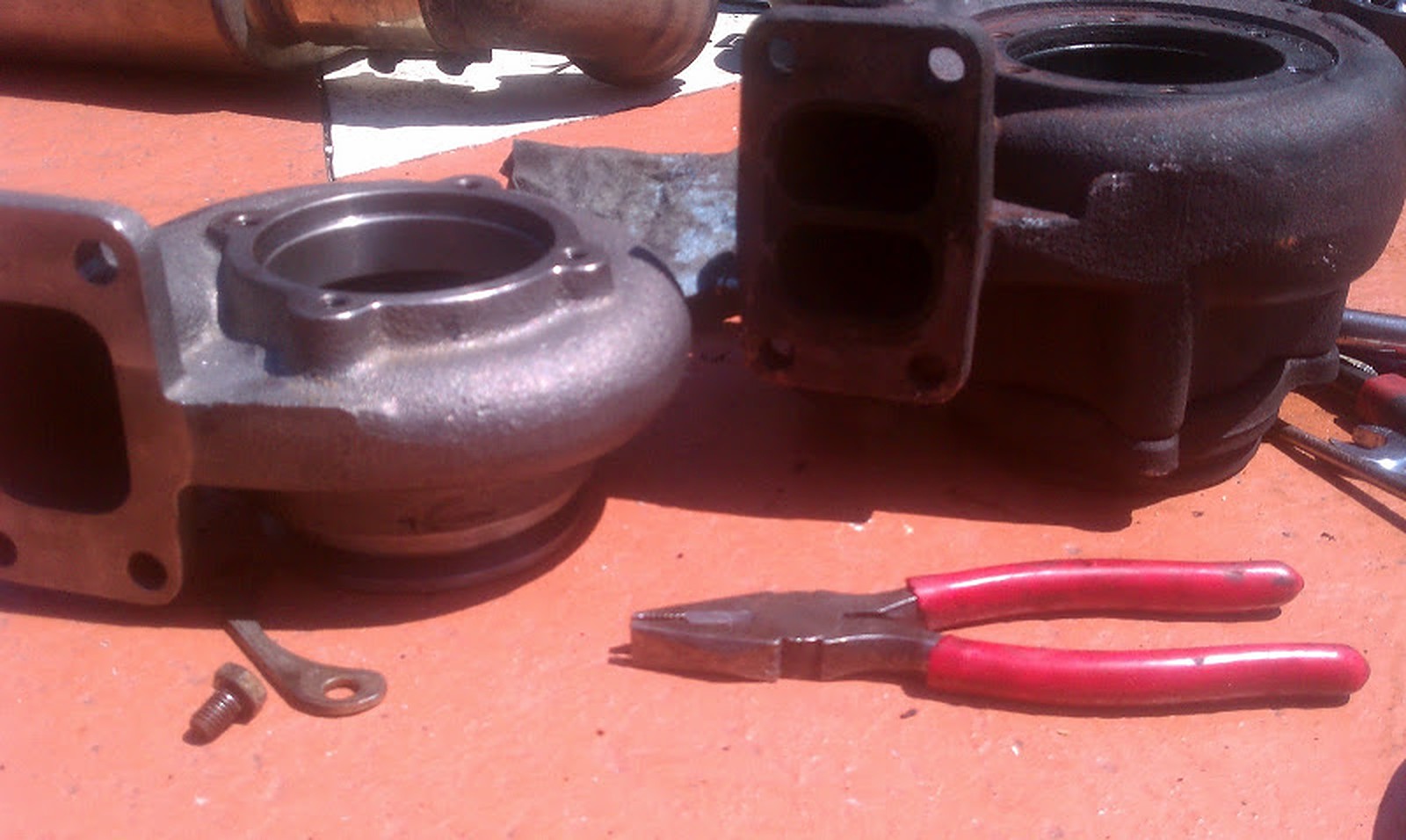
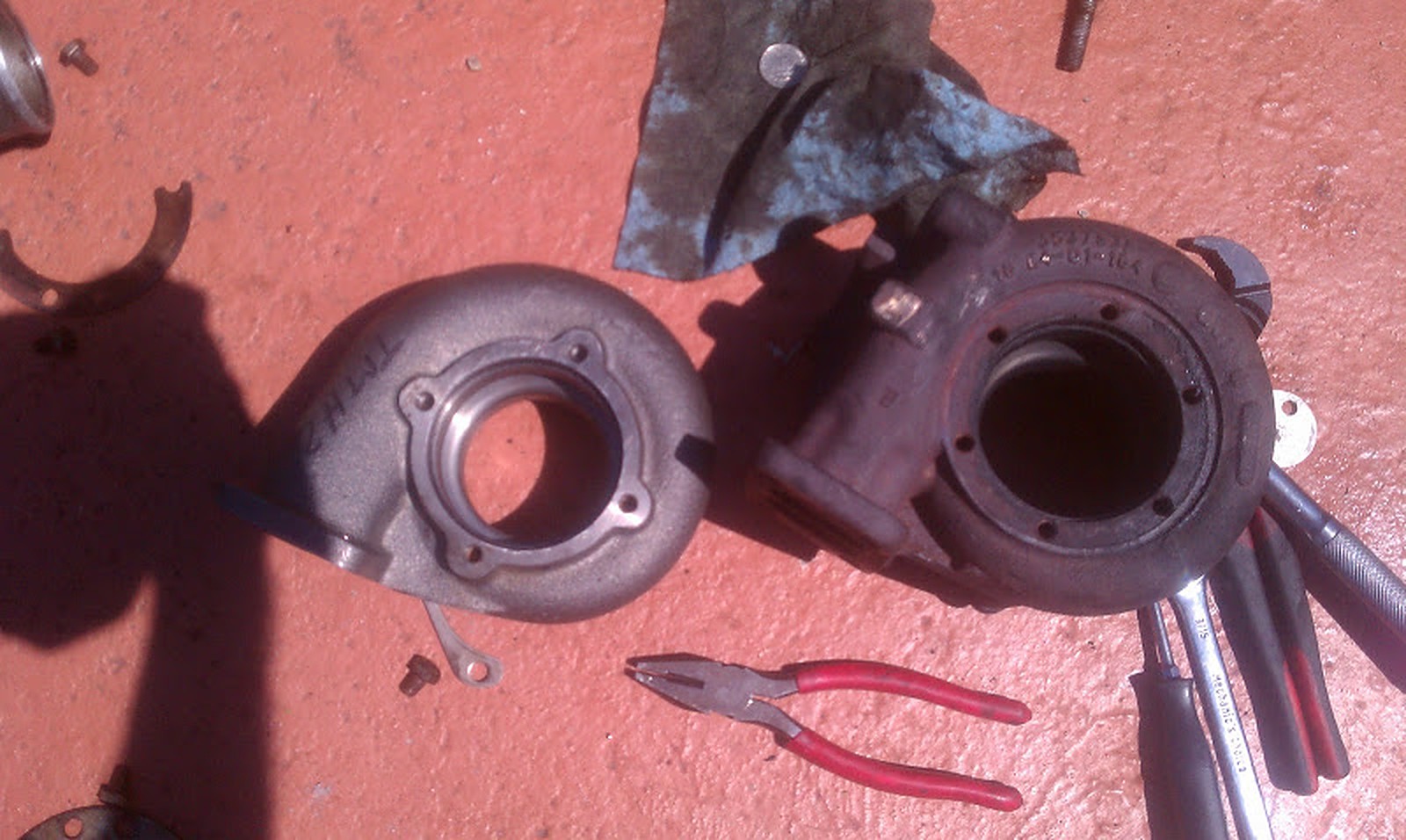
As you can probably notice, most of the build was on a budget, I did not have the freedom to shop for different turbos. However, I did come to a conclusion. VQ’s do not like T3 turbines in my opinion, VQ’s flow a lot of exhaust and require a T4. The T04b T4 turbo I had at 16psi on the VQ30 outperformed the VQ35 with a T3 Holset housing. Let me show you what led me to conclude this, observe this dyno chart below.
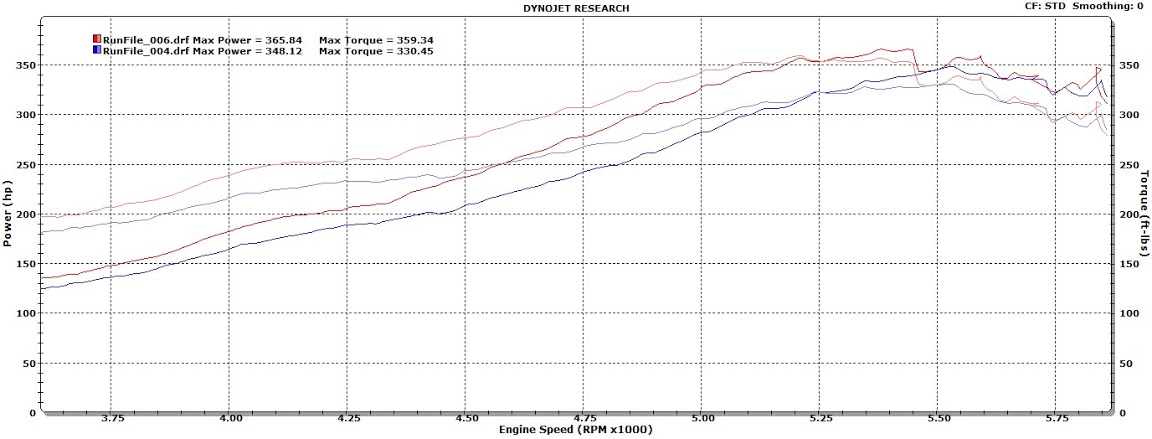
Do not let the dyno numbers mislead you, this is about mid to low 400’s, they show as 300’s because the dyno was done with the torque converter unlocked (this is why I do not dyno very often, they do not add any value other than a safer tuning environment in my opinion). Notice that around 5500 RPM both dyno runs end up at the same power and torque output roughly. One was at 14psi and the other was at 18psi yet they both choke at 5500 RPM. I did a lot of research and asking around and concluded that the T3 housing was the cause. So my advice to you is, start with a T4 turbine and forget about being able to spool quicker with one, once you get the urge to gain more power you’ll regret having used a T3.
Here’s the video of the Dyno. I never recorded a video with the Bullseye housing but it was about 1,000 RPM sooner in spool up with it.
What would I do different from the beginning?
Nothing, my experience led me to learn all aspects of the turbo system and near the end of the rear mount turbo journey I feel I had perfected it. I have no doubt that had I kept the rear mount and used the proper size turbo, it would have performed as well as my front mount does; you can read about the front mount build. https://www.my4dsc.com/streetzlegend-front-mount-turbo-build-part-1/
Rear Mount vs. Front Mount
After years of using the rear mount I eventually changed to a front mount turbo. I have been asked many times why did I make this change if the rear mount turbo worked well. My first reason was because I wanted to learn how to weld so I decided to fabricate my own front mount system. The 2nd reason was weight reductions, getting more serious with racing meant weight needed to be addressed on an already heavy automatic GLE Maxima. The rear mount turbo specific parts were 80lb’s in total in comparison to the front mount. Although there were benefits in going with a front mount turbo it was never a thought nor a plan todo so. I received a welder as a gift, the maxima was no longer a daily so I jumped into putting together a front mount.
When I changed to the front mount using an HX40Pro Holset turbo the spool was similar. At the time I had a .70ar T3 Turbine housing which meant the turbo spooled up very fast both in the rear and the front. I have come to the conclusion that the difference between having the turbo in the front vs. the back does not affect the spool up as much as one would think.
Would I do another front mount? Absolutely yes, I still want to see what a rear mount turbo setup can do with a proper size turbo and I know some of you are working on it or are planning too, so I am excited in sharing this information with you.
I believe my best was 12.8 at 117MPH in the 1/4 with Holset turbo at around 20psi
I hope you have enjoyed this article and if there are questions left unanswered do not hesitate to contact me through social media, Facebook (http://facebook.com/fastmaximas) , Instagram (http://instagram.com/fastmaximas) or email at info@fastmaximas.com. Fastmaximas.com also offers nitrous, intercoolers among other parts and drag racing wheels https://www.fastmaximas.com/shop.


Comments are closed.