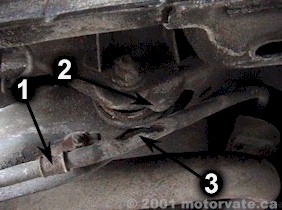
When some mechanics put your Maxima on a hoist, sometimes the “lift arms” of the hoist bend the parking brake cable bracket. (item 1)
This causes the cable to pushed into the very front pivot point of the rear suspension (item 2)The result is a split parking brake cable (item 3), where salt and water can corrode the cable causing it to seize.
Solution:
Slightly bend the parking brake cable bracket (item1) away from the rear suspension pivot point.
Summary:
Simple fix. As you can see on mine it was too late, the cable has been cut, and dirt and debris have probably got in the cable.
Changing your coolant on a regular basis is very important to the longevity of your engine. With normal use, the corrosion inhibitors loose their effectiveness. Nissan recommends that AFTER the first 96,000 KM replace the coolant every 24 months, or 48,000 KM. The procedure that I am following is detailed in the Nissan Maxima’s Owners Manual, in the “Do it Yourself section.”
The engine must be COLD! Do not try this on a WARM or HOT engine. You may warp the block or the heads!
First we must open the valve in the heater core, to allow the coolant to drain out of it. There are two way to do this, depending on the type of climate control you have.
Manual Climate Control
Turn the ignition key to “ON” (one position before “START”), and put you heater control to the maximum hot position. Turn the ignition key back to “OFF”
Automatic Climate Control
If you have the Automatic Climate option (as shown below) you need to do the following to open the valve in heater core:
Turn the ignition switch from the “OFF” to the “ON” position
With in 5 seconds of being switched “ON” push the “OFF” button on the climate control for at least 5 seconds.
Press the “HOT” button 3 times
Press the “DEFROST” button 2 times. Code 43 will be displayed.
Wait 10 seconds before switching the ignition to “OFF”
I like to use a pan like the one shown to catch the coolant. You can use a pail, but then you may have to jack up the car in order to get the pail to fit under the car.
This is the PLASTIC drain plug that is in the bottom of the radiator. Use a large Phillips screw driver to remove it.
Coolant draining from the radiator into the container.
Remove the radiator cap.
Remove the clip on the radiator, and pull off the hose. This hose goes to the reservoir tank. Right:
Here is an inside view of my reservoir tank. It is very dirty, and needs removed to be cleaned. Once the hose is removed from the rad, the reservoir bottle can be pulled out of it’s bracket. Flush out the reservoir with a hose, and maybe a small brush to get it clean. Reinstall the coolant reservoir, hose and clamp.
INSET Photo: Cleaned reservoir bottle.
Front coolant plug. This is used to drain the coolant from the front bank of cylinders.
Rear coolant plug. This is used to drain the coolant from the front bank of cylinders. Your owners manual has a nice picture to show you their location.
These plugs are VERY difficult to access! If you remove the Y-pipe (factory or aftermarket) you will have more room. Remove the plugs, let the coolant drain. Use thread sealer on the threads, and tighten to 13-15 foot-lbs
-OR-
Don’t remove these plugs. At most the engine may contain about 2 liters of coolant. When I added coolant the rad took 5 liters (total engine engine/rad capacity is 7 liters, plus 2 liters for the reservoir). Most of the coolant is being changed (5 out of 7 liters), and from now on, I will change my coolant using this method every year.
What ever you decide to do, you should flush the rad with water. This will remove any sediment and the old coolant. To do this, simply put the water hose in the filler neck of the rad, let water flow thru the rad, and exit the bottom. Make sure that you capture all the coolant in a container, for recycling.
Install the rad drain plug. Make sure the rubber washer is in place. (indicated by arrow)
Check the rad cap for any tears in the rubber. Using a clean rag, wipe off any foreign matter on the rubber seal. Gently lift up the metal “hat” as shown by the arrow, and wipe off the “hat” and rubber under the “hat” This is the valve the allows coolant to enter the rad, from the reservoir bottle as the car cools.
Make life easy for yourself. Pre mix a 50/50 mixture of coolant and soft water. This will protect you from -37°C to 129°C.
Pour in the 50/50 mixture S-L-O-W-L-Y. This will allow time for air to escape.
Install the radiator cap.
Start the engine, and let the car warm up, until it reaches operating temperature.
Race the engine 2 or 3 times in neutral. Keep an eye on the coolant temperature, just incase the motor starts to overheat.
Let the engine completely cool down.
Top off the rad to the bottom of the hole for the reservoir hose.
Fill reservoir to the “H” mark with mixture of 50/50 coolant and soft water.
Check the rad drain plug for any signs of leaking
Recycle the old coolant
After a few days, with the engine cool, check for leaks, check the coolant level, and check the freezing / boiling point to ensure it meets your requirements. For most of Canada, a 50/50 mix should protect you. (down to –37°C)
Do not leave the old coolant in an uncovered container.
Animals like the smell and taste (very sweet) but it will KILL THEM. Recycle it as soon as possible!
The knock sensor plays a very important role. It listens to the engine. When it hears engine knock it sends a signal to the ECU. (Engine Control Unit) The ECU normally will delay (or retard) the ignition advance. This stops the engine knock, and decreases engine power.
Engine knock can be caused by using lower octane gas than is recommended by the manufacturer, or by over advanced ignition timing. It can also be caused by a “hot spot” in the combustion chamber. During high engine load, some carbon that has accumulated in the combustion chamber can glow red. This can cause the air-fuel mixture to ignite prematurely. This is PRE-IGNITION, and it is the equivalent of taking a very large hammer and hitting the piston before it rises to the top. (TDC, top dead center) This sends a shock through the engine, and the knock sensor “hears” the knock, and tells the ECU.
For the past year, my ECU would have the code 34, knock sensor failure. I would reset the ECU, drive for 5 minutes and the code would return, BUT the check engine light (CEL) never came on. The car was running great, so I didn’t think it was in need of urgent repair, as I ALWAYS use Sunoco Ultra 94.
Early 4th generation Maxima owners were telling stories of amazing increases HP, as measured by the BUTT DYNO. (yes, it was SAE corrected) I wanted to see for myself.
Knock sensor location. It is not very easy to get at. I was able remove the knock sensor WITH OUT removing the ENTIRE intake manifold. My hands were cut up quite a bit, and it was painful, but I was done is 30 minutes. To remove, simply loosen and remove one bolt. Gently pull the knock sensor harness to remove it from the “V” of the engine.
Close up of the knock sensor.
Close up of the knock sensor. This is the bad one, with just over 235,000 Km on it.
Connect the new knock sensor to the knock sensor harness. This will prevent it slipping out of your bleeding hands, and fall to a spot that you can not reach. The red connector at the knock sensor only has ONE wire, however on the other side of the knock sensor harness there are 2 wires. Everything is fine, the sensor has a braided wire shield that is grounded. If the knock sensor falls to the floor, it can be easily damaged. BE VERY CAREFUL WHEN HANDLING THE KNOCK SENSOR.
Tighten the knock sensor bolt by hand, until the it is snug. I had just enough room to get a wrench on the bolt and tighten it. If you over tighten, the knock sensor will be VERY sensitive, and if you under tighten the knock sensor will not se sensitive enough. The factory spec is 15-20 foot-lbs.
The knock sensor is grounded by these two 10 mm bolts. Remove them, lightly sand the connector on the wires and the flat area on the intake manifold, then tighten the two bolts. This will remove any corrosion.
Any Difference?
After a few days of driving, the car pulled a quite a bit harder. It now has more power in the lower RPM range (<3,000) Is this possible?
Yes. When the ECU is first powered on, it tests all sensors. When the knock sensor would fail, then it uses a “safe table” which retards the ignition advance slightly. This prevents the engine from knocking, as the “safe table” has values for low octane gas.
When the ECU started up, and saw a good knock sensor, it took time to optimize the ignition advance. The ignition timing advances very slowly waiting for some slight knock. This is how the ECU figures out the octane you are running. HOWEVER, if knock is detected, the timing is retarded VERY, VERY fast. This reduces the incredible stress of knock on your engine. This process repeats over and over.
Summary
If you have a trouble code 34, and your car is 4-5 years old, replace the knock sensor. Don’t forget to clean the ground connection of any corrosion.
A common problem on the fourth generation (1995-1999) Maxima is a leaking oil pressure switch. Mine has had a slight leak for the last 3 years. The leak was so small that it would never drip, the oil would just “sweat” around the switch. I kept an eye on it at every oil change, or anytime I am under the car to make sure it was not leaking more.
When I was under the car to change my alternator, I noticed that the underside of the car by the oil pressure was slightly wet with oil. It is now time to replace it, before it gets any worse. I went to Car Quest and paid just over $20 for it. (I later found out that it is $12 at Canadian Tire)
It is very easy to install. It is better to replace it when you have removed the oil from the car. (like during an oil change) Otherwise, you need to be quick to remove the old switch, and install the new one to reduce the amount of oil that you loose. (It pours out quite quickly!)
The new oil pressure switch.
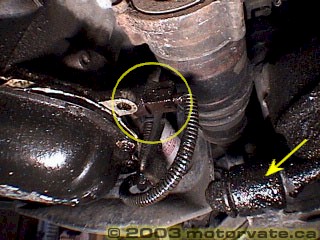
The old switch before it was replaced (yellow circle). Notice the oil on the lower control arm. (yellow arrow)
Remove the rubber boot, and gently pull on the connector to remove the wire.
Switch with boot, and connector removed. Notice the oil drip on the bottom of the switch. (yellow arrow)
You will need some thread seal tape, to ensure the new switch does not leak.
Simply wrap it around the threads in the direction OPPOSITE direction of the threads. This will keep the tape from trying to “bunch up” as you tighten it.
Here is the new switch. I used a channel lock to carefully tighten it. You can purchase a special socket for $6 (US) at AutoZone, When I replaced my switch, I did not drain the oil. (it was 3 days oil) With the engine full of oil, you must be quick to remove and replace the switch as the oil pours out quite quickly.
Attach the electrical connector, and push on the rubber boot.
The finished job.
As you can see, this is a simple job. It should not take more than 30 minutes. I would recommend replacing the switch as soon as it leaks, because if it it leaking a little, it could easily leak a lot. In a worst case situation, your could loose all your oil and seize your motor for a $20 part. The $20 is money well spent. (In the US the cost is about $8)
With any front wheel drive car, after a while the constant velocity (CV) boot will have to be replaced. This may be due to the boot being ripped open, or (in my case) due to the boot cracking after 240,000 + KM.
If the boot has been ripped open, you may be able to change just the boot, *IF* you notice it quickly. Once it is has a rip in it, the CV grease is “spun out” of the CV joint, and any road grit or water can enter the CV joint. This greatly reduces the life of the CV joint. If this applies to you, it is better to change the entire CV shaft. This will give you 2 new CV joints, grease and boots.
Quick Test: While moving very slowly with the window open, turn fully to the left or right. If you hear a “click-click-click-click-click” sound coming from your front, your CV are probably badly worn, and you should replace the entire CV shaft.
As you can see from the picture below on the below, my boot is not ripped. It simply has a deep crack in it. If this is not replaced soon, the crack will continue to get deeper, until the boot is split.
Speaking of split, many people ask me about the “Split CV Boots”. If I trusted them, I would show you how to install them. The original factory boots gave me 240,000+ KM, so I will stick with them.
The factory boot was $50 (CDN) and it came with the correct amount of grease, new shaft clips, and the metal CV boot straps. (above right picture)
Raise the front wheels, support the car with jack stands, and remove the front wheel. Always work safe, and use proper jack stands that are in excellent working order. You life may depend on it.
Remove the bolt that holds gear indicator switch.
*CAREFULLY* remove the switch. Make sure you have a large bin that can hold at least 5 liters under the transmission to catch the gear oil. (factory fill is 4.4 liters)
Remove and discard the cotter pin from the CV shaft.
Remove the sheet metal castle nut. (this prevents the CV nut from coming off the CV shaft if it ever came loose)
Use a 36 mm, 6 point deep socket to remove the CV nut. You can use an air gun, or use the method shown below:
Which ever method you use, be prepared: This can be one tough nut. The 6′ floor jack on the 1/2 inch ratchet never fails, but sometimes the ratchet does. It is now in pieces.
Remove the 2 large bolts that connect the strut to the steering knuckle. (17 mm bolts, 19 mm nuts)
Remove the ABS sensor wire from the strut by gently pulling it off.
Remove the clip that holds the brake line. Make sure the screw driver does not slip, and damage the brake line.
With the clip removed, wiggle the brake line to remove it.
Using a large screw driver, pry the steering knuckle from the strut. Make sure that the ABS sensor wire, and brake line do not get pulled tight when you pry the steering knuckle out.
Pull the steering knuckle away from the car, and the CV shaft has just enough room to separate from the steering knuckle.
Use a large screw driver to pry out the inner CV (not shown). Make sure you don’t damage the inner CV seal or your tranny will leak.
Place the CV shaft in a vice, and remove the metal CV boot clips using a flat blade screw driver.
The outer CV joint is simply pulled from the CV shaft. I used a slide hammer to pull on the CV, with the CV shaft in a vice. It pops off fairly easy this way.
Here is the inside of the CV. As you can see there is lots of grease, and the grease is in good condition. After a while, the grease may turn “watery” or dry out and turn into soft clay. If this happens, your CV is probably quite worn.
Soak the CV joint in turpentine to remove most of the grease. I found that lifting the CV in and out of the turpentine helped. After 10-15 minutes, use any type of “Brake Clean” product to remove the rest of the grease.
With all the grease removed, the CV will look like this. Nice and clean.
Remove CV shaft retaining clip (indicated by the yellow arrow), and then the old CV boot.
Wipe the shaft with a clean cloth. Place the new small CV boot clamp on the shaft. (Very important!)
Cover the end splines with tape, and apply a little CV grease. This is to prevent small cuts in the CV boot as it slides over the shaft. Gently push on the new CV boot until it touches the small raised part on the CV.
Install the CV retaining clip. Use CV grease to keep it properly centered. (as shown) This will make for easy installation of the CV joint, as the clip will compress the easiest, due to being centered.
Squirt about 1/3 of the tube of grease in the CV where the shaft will go. Use your finger to pack the grease against the other side of CV balls and the inside of the CV joint.
Align the CV on the splines. Make sure the retaining clip is still centered, and using a rubber hammer, gently tap the CV joint on the shaft until you can not see the splines. You will feel it click, and hit a firm stop. When tapping on the CV Joint, make sure that you hit the nut, and not the CV shaft threads!
Use about 1/3 of the CV grease and pack it on the CV balls, and ball cage. The last 1/3 is placed in the CV boot. Make sure you use all the grease that comes with the Nissan kit.
With the CV boot in the proper groves on the shaft and CV joint, gently pry open the boot to remove any build up of air pressure, using a screw driver.
Here is the final result: a nice and shiny boot.
Place the CV shaft in the transmission, and push it in until you hear and feel the click of the retaining clip. (TIP: use a small amount of thick grease to hold the inner CV retaining clip in the center of the shaft to make it slide into position easier.)
Tighten the struck to steering knuckle bolts. Place the brake line in the bracket, and install the retaining clip. Connect ABS sensor wire grommet to the supporting bracket.
Place the CV shaft washer, and nut on the shaft, and tighten to spec. (This requires LOTS of force, 174-231 foot-pounds!)
Whenever the steering knuckle has been removed from the strut, you should have your alignment checked. The odds of it being back in the exact same position is very small, and you don’t want to increase the wear rate on your front tires.
Install the gear position switch, and tighten the 10mm bolt.
With both CV installed, pour in the gear oil until is start to pour out the fill hole. Install the tranny oil fill plug. Make sure to only use GL-4!
Just before installing the tires, double check everything you touched. Install the tires.
Time for a test drive. During the test drive listen for any new noises. After the test drive, check for any signs of leaks, and double check all nuts and bolts you loosened.
REMEMBER:
If your CV make a clicking noise when you turn, you probably need to replace the entire CV shaft.
If you boot has been torn for an unknown time, your best bet is to replace the whole CV shaft.
If your CV boot has just torn, or if your CV boot has deep cracks, then just replace the boot and grease.
This is not a difficult job. The hardest part is getting the CV shafts off the car. After that, it is quite easy.
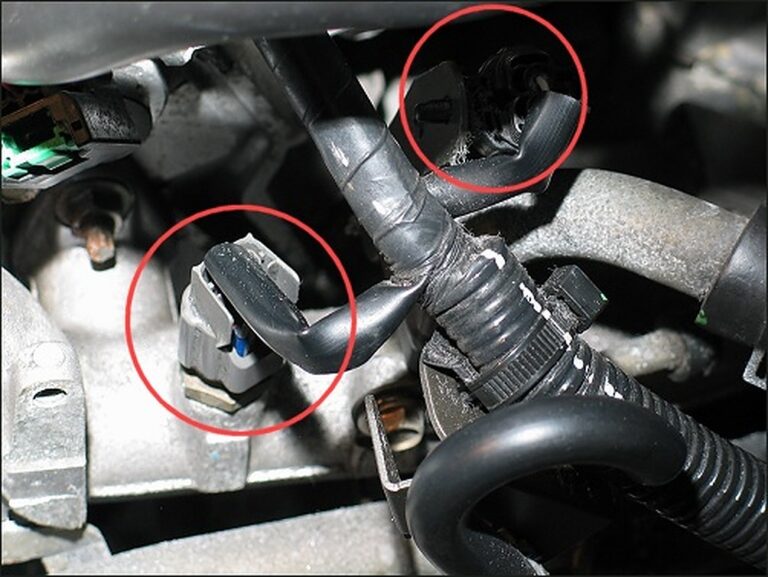
On the 4th Generation Maxima engine the Engine Coolant Temperature Sensor is located in the water outlet tube close to the engine end of the upper radiator hose. There are two sensors in that area. The one nearest the hose is for the dashboard temperature gauge. The ECTS, the one you’re interested in, is right next to the the gauge sending unit. There is a good picture of these sensors in the Haynes manual on page 3-7.
With the engine cold, disconnect the ECTS and measure its resistance. Reconnect the ECTS, start the engine, run it until fully warmed up. Stop the engine, and repeat the resistance measurement. The “warm” reading should be a much lower value than the “cold” reading.
The specs for the ECTS are:
Engine coolant temperature 68F, ECTS resistance 2.1 – 2.9 Kohms
Engine coolant temperature 194F, ECTS resistance 0.24 – 0.26 Kohms
Replacements Symptoms/Notes:
Below about 30 degrees idle will die if I don’t keep my foot on the gas at startup. Once engine is warm it’s OK.
Just a quick update for anyone having the same problem. Replaced the CTS (ECU Temp sensor in the picture) and guess what? My multi-year cold start problem is OVER! She runs like new again. Over $1000 spent on MAF, TB cleaning, and more and all I needed to do was replace a $9.00 sensor.
Your MAF is located on your air box between your Throttle body and Air filter. It sets about 8-12 inches back from the air filter itself. It has 2 Torx screws holding it down.
The 4 wires are color coated as follows (2000 model) from right to left. (From passenger side to driver side) (Left to right in the pictures)
White Wire: Signal wire – This will change as your speed/load changes – This is the wire the ECU/TCM takes information from to alter shifts, A/F ratio, timing,etc.
Red Wire: Reference wire – This should stay the same. This wire is from a hot source and has some sort of resistor to send only 5 V to the wire.
Black Wire: Ground wire – Should be .05 or less VD from battery ground.
Red Wire w/ Green Strip: power wire – Should be battery voltage.
Thanks to puppetMaster for the MAF signal specs they are as follows. All readings are at Engine operating temp, and no load. ( radio, head lights, ac, heat off).
Reference Wire (Red Wire): should be @ or just below 5 V. If this is low your MAF signal wire will send low #’s to the ECU.
GROUND WIRE (Black Wire): .05V or less – Should not change more than .02 volts with load or engine speed increase.
POWER WIRE (Red with Green Strip) Battery voltage. (13 – 15V) Should be close to the voltage you get when checking battery terminal to terminal. Alldata says 11-14.
IMO- If you have 11V your battery is either dead or you have an electrical problem….. again-IMO.
I couldn’t find any specs for the ground or reference so these are universal specs among all domestic/import MAF sensors.
Obviously a tranny. I used my old ’95 tranny with 108k. (My current car has 180k)
Amsoil synthetic GL-4 tranny fluid. Pricey but recommended.
Alright, step by step removal down to the tranny. First may I note that I think I did this with removing the least amount of stuff possible. I left the cross member on and y-pipe on. Removing these will obviously make removing the tranny easier but is optional. PS: if you remove the cross member you will need to support the engine.
Step One:
Start draining the fluid. Draining the tranny fluid takes a long time so start with this right away. I didn’t and I had to wait for while. This pic shows the bolt that is removed to do this.
Step Two:
Remove the driver side wheel.
Step Three:
Remove the caliper. My 300zx calipers were held on by 2 17mm bolts in the back. Use a wire or zip tie to hold them on the springs so they don’t hang by the brake line.
Step Four:
Remove the Rotors. Mine just slid right off.
Step Five:
Now remove the cotterpin and the washer behind it. Use a pliers.
Step Six:
Remove the 36mm axle nut. Impact gun is strongly recommended. There is also a washer behind it so keep track of that too.
Step Seven:
Disconnect the hub from the struts. It is a 19mm nut on a 17mm bolt.
Step Eight:
Now pull the hub off of the axle. I also used a hammer to help start push the axle out. I again used a ziptie to hang the hub from the strut so it would not pull the ABS line tight.
Now to attack from under the hood. Here is my engine compartment before doing anything. Mostly a mess, I know.
Step Nine:
Remove the intake. Disconnect the vac hoses, MAF and air temp plugs, and disconnect from the throttle body.
Step Ten:
Remove the battery and battery tray.
Step Eleven:
Remove the Starter. This involves disconnecting the big positive cable and the other connector. Then unbolt the 14mm and 17mm bolts.
Step Twelve:
Remove the slave cylinder. This was held on I think by two 14mm bolts. They are hard to get at so I had to use a wrench. Then also remove the ground wire that is bolted right next to where the slave cylinder is.
Step Thirteen:
Remove the tranny mount. First remove the long bolt that goes through it. Then the 4 bolts that hold it onto the tranny. Also notice the oil everywhere?…no wonder there is none in my tranny…it is instead all over everything else!
Step Fourteen:
In order to access a few tranny bolts, it is also necessary to remove the shifter linkages/rods from the tranny. It is ok to let them hang from where they connect to the shifter. Also 1 of these bolts is a pain to get at with out taking off the cross member but I did it with a wrench.
(sorry no pics of this)
Step Fourteen point five:
Also make sure the crank position sensor on the tranny is unplugged and the gear sensor is unplugged. I removed the crank position sensor completely.
Step Fifteen:
Now you should have everything off of the tranny. So now remove all the bolts holding the tranny onto the engine. There should be 8 since one was already taken off with the starter and one with the shifter rod. KEEP TRACK OF THE BOLTS! There are different sizes, what I did was I drew a picture of a circle and placed the bolts on the circle relative to each other on the tranny. 2 of the bolts on the bottom of the tranny I could not completely remove with the cross member still on, but I didn’t need to since they were completely unthreaded from the tranny. Once all the bolts are out its time to take off the tranny. What I did which isn’t recommended as the best, was place a jack under the tranny (but not pushing up on it) and then I used a screw driver to pry it from the engine. Then with the tranny sitting on the jack, I lowered it down. This isn’t recommended cause it is very hard to balance a tranny on the jack.
Step Fifteen point 5:
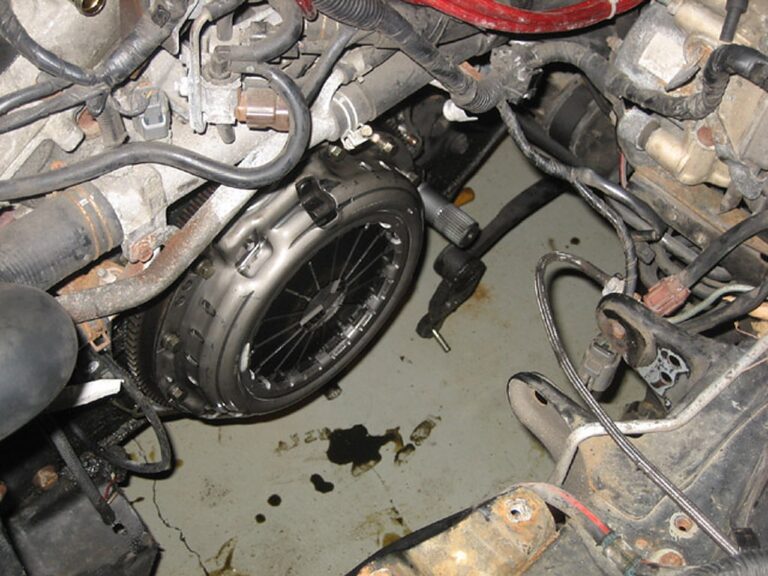
Remove the clutch. It is held on by I think 10 12mm bolts IIRC.
Step Sixteen:
Remove your flywheel. This is held on by 8 14mm bolts. I used an impact gun with a 14mm impact socket. These bolts are very tight and using a ratchet is difficult unless you can effectively stop the flywheel from rotating.
Step Seventeen:
Assemble lightened flywheel from stock ring gear, timing gear, and the stillen piece.
Step Eighteen:
Reassemble everything in reverse order, making sure to torque everything to spec and to replace the axle seals, and then refill with 4.8ish quarts of tranny fluid. DO NOT use an impact gun to install the flywheel and clutch onto the engine. These bolts are weak and can break…don’t ask me how I know.
Edit: Thanks to nismology for pointing this out, when refilling the tranny, do it with the car level on the ground and refill until oil comes out of the refill hole (It takes approximately 4.8 quarts)
Other notes…reinstalling the tranny was a major PITA since it’s so heavy. I recommend using a tranny jack. If you don’t have a tranny jack and if you aren’t super buff, you should remove the passenger side axle. It’s the same steps as the driver side with the addition of removing 3 bolts for the bracket that holds the axle to the engine.
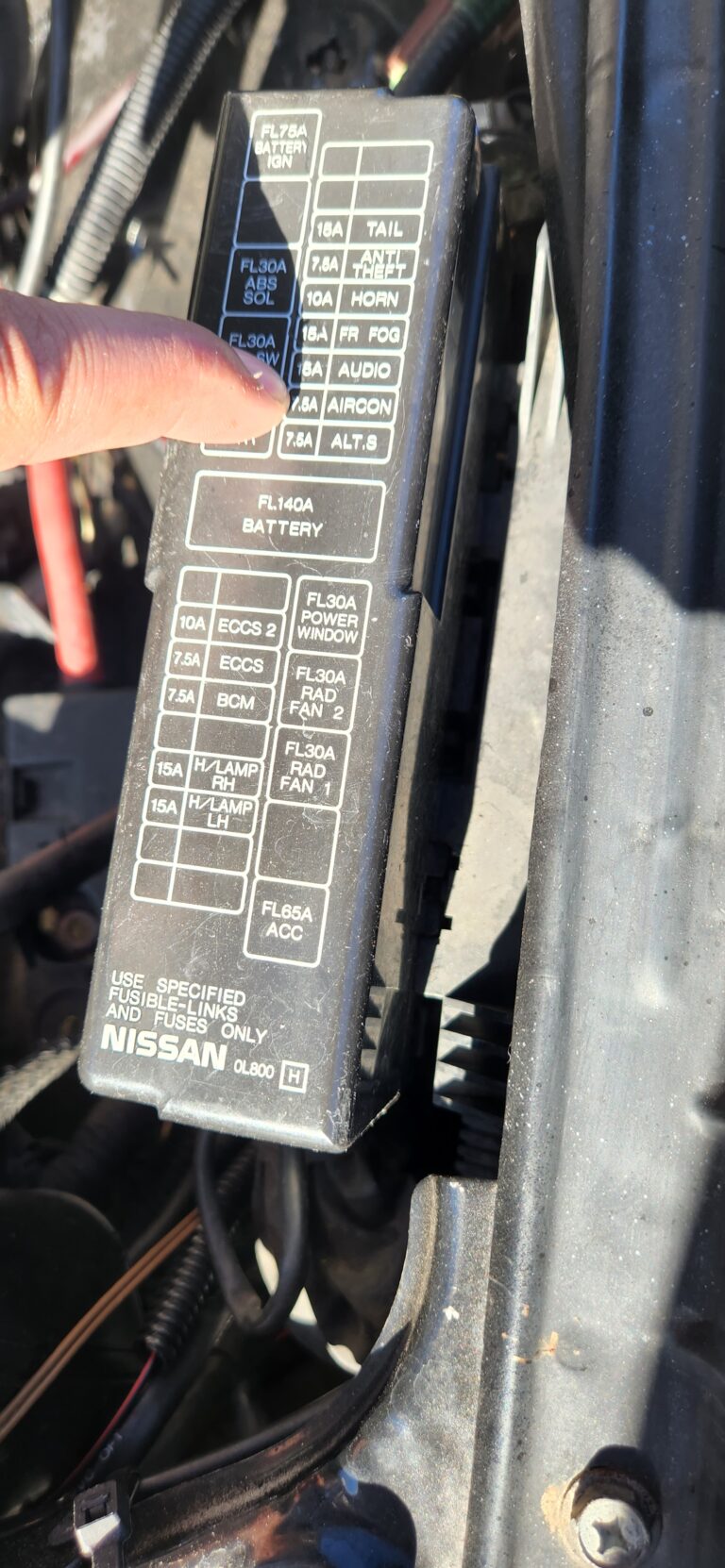
My air conditioner had stopped working all of a sudden. I tried to add R134A refrigerant but the gauge was showing it was full. At first I was thinking I may need a new AC compressor. But before that I decided to do a few basic checks.
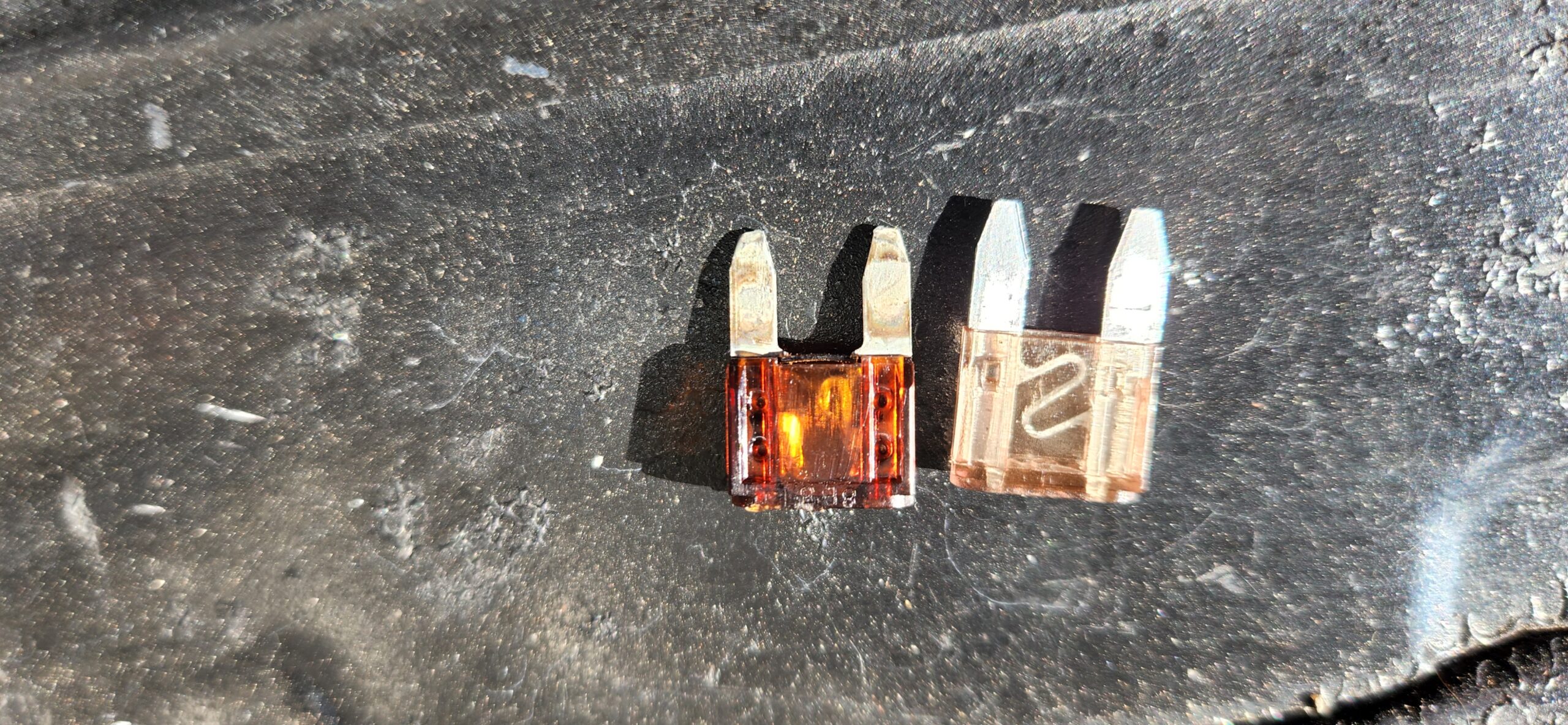
First I checked the sub-harness where you plug-in the compressor and alternator. I noticed the alternator pigtail was in very bad shape. I replaced the harness with a used OEM one and then I went to check the AC fuse. To my surprise it was blown. Soon as I replaced it, the AC compressor kicked right on.
The R134A refrigerant gauge now read low but a good sign since it just needed more. I refilled it with a full can of R134A refrigerant and now the AC is ice cold, super ice cold. I suspect it was the bad alternator pigtail that probably caused two wires to trough. This is what likely caused the 7.5 amp fuse to blow.
Now back to cruising with a nice COLD AC in this summer weather.