
Tag

Injectors

Browsing

Credit: Ahmed H.

This is something I posted in another group. Here is a small informative write up on something I ran into little while back.

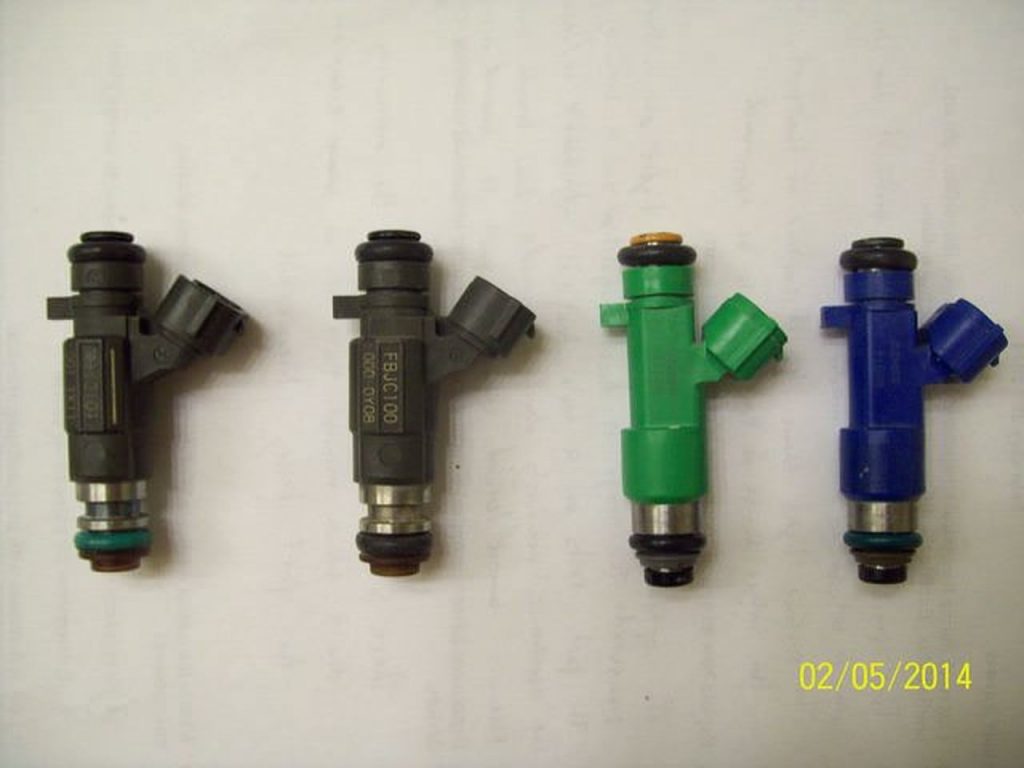
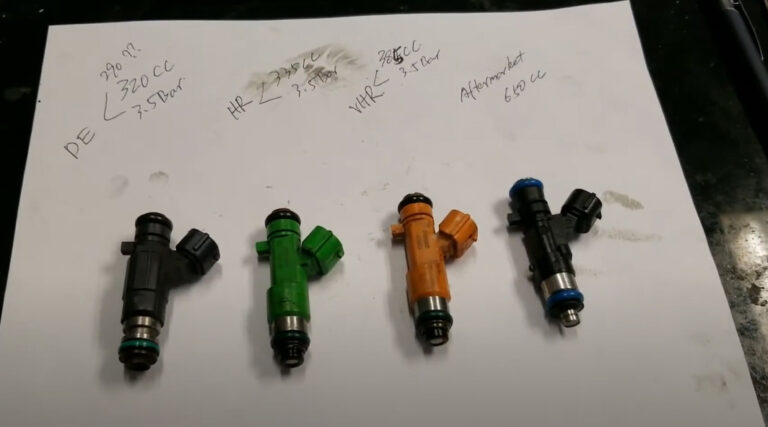
Here are two different GTR injectors. One is claimed to be as “remanufactured GTR injector” and the other one is as real GTR fuel injector that I removed from a customers car.

As a tuner we often have cars brought in and deal with different brands of fuel injectors which is fine as long as the injectors are consistent across the board and it is incredibly helpful if they are normally supplied with a data sheet. Such as flow matching, minimal injector pulse with, fuel injector dead time, injector PW compensation, pressure differential dead time etc.

This customer asked me to tune their G37 with “reman” GTR injectors but I had requested that I would see them prior to installing them.

Just looking them over, you can clearly tell which one is the fake “GTR” injector. The molding is different, the brand logo is slightly off, the area where the Oring sits is very off, the spray pattern cap isn’t drilled at the correct angle, and what really gave it away as soon as I took it out of the box was the electrical terminals and connector.

So why is it important to run a known matched/reputable set of injectors? For many reasons, but one of which is drivability. As a tuner, we can tune a set of injectors on the dyno, to try to give you as much of the OEM drivability and consistency as possible. But with low quality fuel injector, you will end up with sporadic drivability after the car is off the dyno and in real world driving conditions. Some of the issues that can be encountered with knock offs are fuel trims will constantly change (sporadic), check engine light DTC, power loss, misfires, lean conditions, per cylinder fueling will be off etc. the list of issues can be very long.

Couple of the reasons for these knock off parts causes these issues is their inconsistency of performance due to voltage change, temperatures change, and being closely flow matched at low injector duty cycle such as idle, light throttle, cruising conditions, etc.

Here’s an example: let’s say at idles, your engine needs 2 milliseconds worth of fueling. Your tuner has input all the right data for the injector on the dyno. After getting the engine warmed up, now your tuner will adjusts the fuel table to get a good idles and stable fuel trims.

Let’s also say you bought the knock off injectors you were warned not to buy. Looking at the data, you’re idling at 2 milli seconds when the engine is warm. You drive the car home, next morning you start the car and it cranks for a while before it starts then after it starts you get weird misfires. Knock injectors can easily change in operation by .5 milliseconds. Doesn’t sound like much but that 25% of your fueling at idle. Things get works when you turn on the A/C, radio, and defroster.

The cars ECU can usually accommodate up to 25% of fueling at low loads, but will worsen as voltage changes and engine operating temperature changes. The reason is the injectors are performing different at different temperatures. This is why OEM and quality brands spend so much time developing their injectors. to give you that optimal consistent cold start, hot start, idle, drivability etc.

Just remember, the reason your car has poor drivability is probably because of your knock offs injectors, not necessarily your tuners fault.

The fueling will be much closer to target fueling under WOT as this .5 milliseconds becomes a much smaller percentage and less noticeable. This is something to look into if your car only runs great at WOT and nowhere else.

Hope this helps saves you from having to deal with a future hassle. P.S. of course Fb took a lot of the resolution away from these pics. Also, the real injector is on the left of you have noticed.

Cheers!

Fake

Real

Loading

Member Credit: schmellyfart

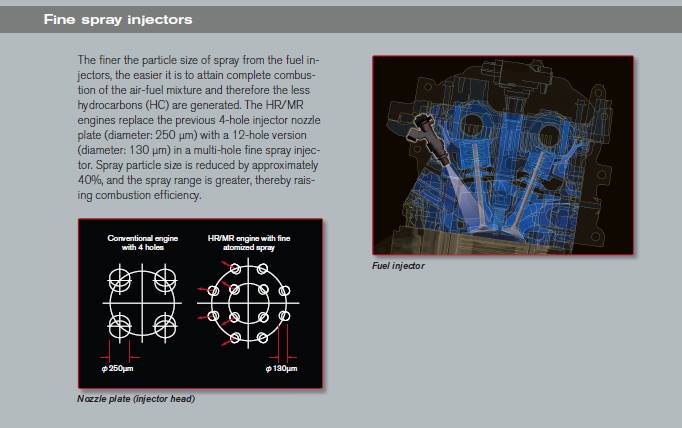
I was reading one of Nissan’s technical documents on the HR engine and its improvements HERE when I came across this:

Which then had me wondering if these improved injectors flowed less fuel in FWD applications compared to RWD applications as they did with the First generation VQ35DE. In addition to the flow rate, I was also interested in seeing how the injector spray patterns compared with the different hole configurations.

I had an ASNU Classic Injector Flow Bench at my disposal at school, so I finally took advantage of it, and cleaned & flow tested a handful of injectors to say the least.

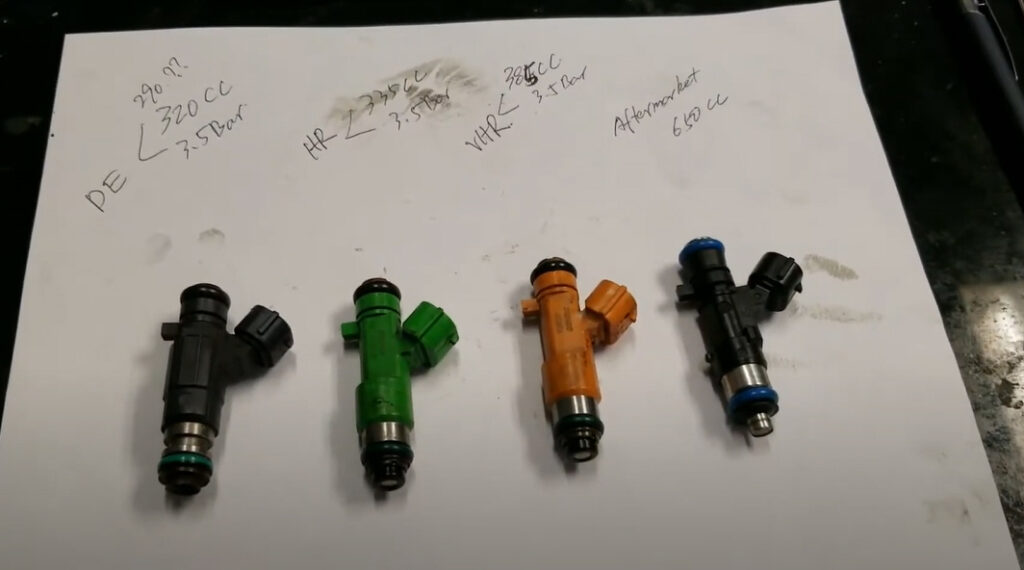
Injectors tested:

  • 21 FBJC100 [VQ30DE-K] 5th Gen Maxima
  • 7 FBJC101 [1st Gen FWD VQ35DE] 5.5 Gen Maxima
  • 12 Green Denso [2nd Gen FWD VQ35DE] 7th Gen Maxima
  • 6 Green Denso [VQ35HR] 350z
  • 6 Blue Denso [VR38DETT] GT-R

Test Procedure:

  1. Each Injector was run on a 10 minute automatic cleaning cycle before testing
  2. A test run was then done to set fuel pressure at 3 bar while the injector is spraying
  3. Each injector was tested three times and its results averaged
  4. Each injector test was run for 20 seconds with the exception of the Blue Densos, which were run for 10 seconds

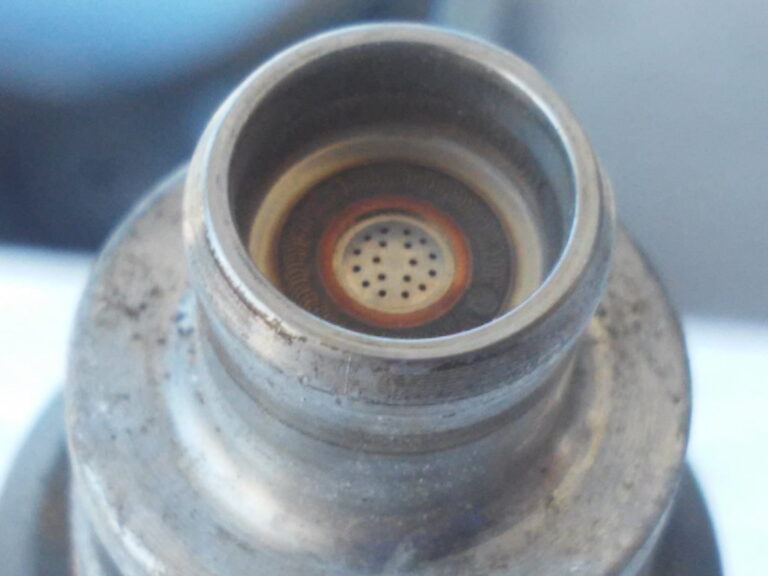
I wasn’t able to take clear pictures of the holes in the injector nozzle plate. So this description will have to do.

FBJC100 – 4 hole
FBJC101 – 18 hole
Green Denso – 12 hole
Blue Denso – 12 hole

Results


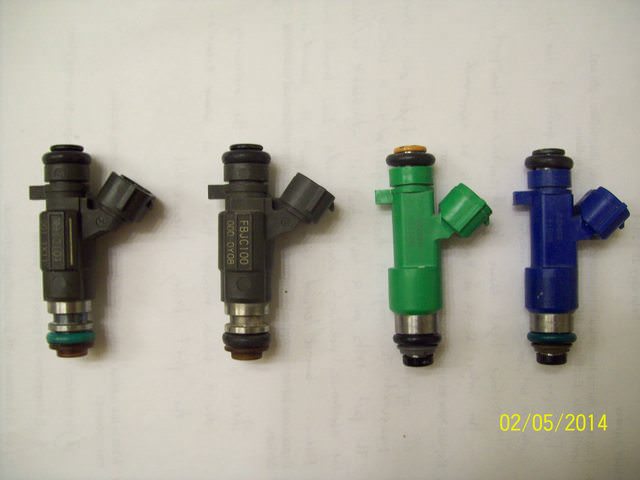
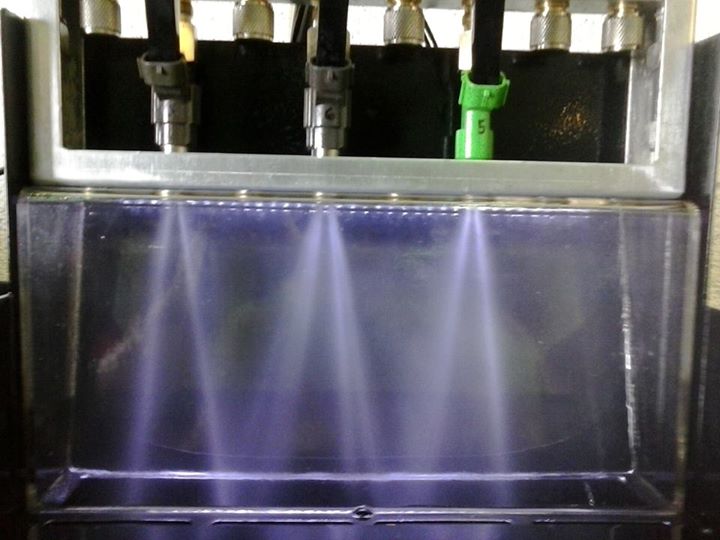
FBJC100 left, Green Denso right


FBJC100 left, FBJC100 middle, Green Denso right

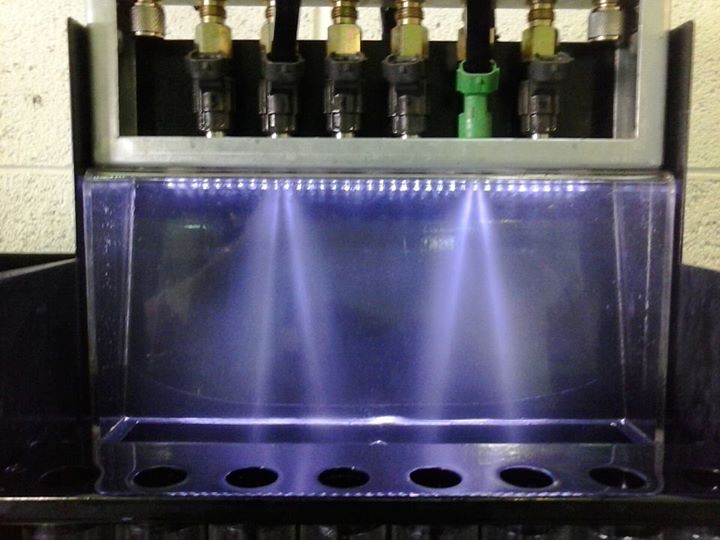
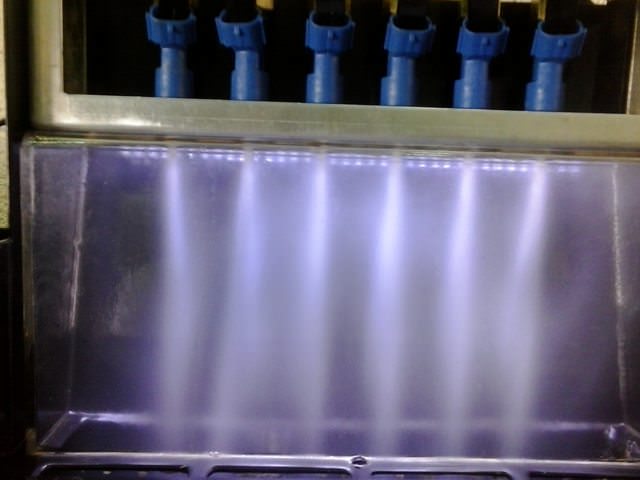
Blue Denso

I also recorded videos of pulse testing as well.


Static Flow Test Results at 3 bar:

FBJC100 – 306 cc/min
FBJC101 – 294.25 cc/min
Green Denso – 309.25 cc/min
Blue Denso – 546 cc/min

To sum it up, the Green Densos in the newer VQ35HR and HR styled 09+ VQ35DE have the same flow rate. At that, they only flow a tiny bit more fuel than the FBJC100, but have better atomization. The Green Denso injectors are also lighter in weight than the FBJC100 at 0.070lb each for the Green Denso, and 0.098lb each for the FBJC100.

Loading

Credit: Finkle

I noticed the 5th gen injectors are 4 hole, and the 5.5 gen are 18 hole. The flow rates are slightly different 306cm/min – 5th gen 294cm/min – 5.5 gen. Besides that, they looked identical.

The article talks about how more holes help atomization. So my thought was, why not try some 18 hole injectors in my 5th gen LIM and see if it helps.

Here is a pic of the 5.5 gen injectors (missing the pintle cap. Many of the caps were stuck in the LIM. I had to pry them out and pop them back on.

First a little back story on my 00VI swap:
August of last year I completed the 00VI swap with the 4th gen LIM and IACV. 5th gen TB, UIM (obviously), and EGR delete.

June of this year I swapped the the 4th gen LIM with the 5th gen LIM. (I had no way to tune at the time of my initial 00VI. I added a Emanage Blue in the spring) I felt a little bit of improvement over the 4th gen LIM. Not a big boost, but every little bit helps. Tuning is not my strong spot, so I’m running on a basic street tune. I’ll work on getting the map fine tuned when I get around to it. WOT runs 10-12 AFR.

I took a quick trip to the junkyard and picked up 6 5.5 gen injectors. They fit right in, no issues at all with the install, even the plugs are the same. It was more of a pain to take the UIM off for the third time in a year. I cleaned them first, just as I did with the 5th gen 4 hole injectors.

I didn’t touch the tune, I figured the difference was small enough I could take on the task of tuning later.

My first impression is WOW. These new injectors are great!!! I can’t believe I haven’t heard about this on the .org

Mid throttle low RPM made the most improvement. Not a lot of gain at high RPM, but no losses. The best gains are below 3500 rpm at mid throttle. Idle seems a little smoother to boot. This is a great mod, especially if you are doing an 00VI with the 5th gen LIM. I can’t get over how much more power I have below 3000rpms. Without touching the tune from the 5th gen injectors, I’m running 12-12.7 at WOT. SO that problem seemed to take care of itself.

It’s too early to tell, but I’m hoping my gas mileage might go up slightly also. You know the spot your used to resting your foot to keep a certain speed (25mph, 55mph, etc.) I had to re-learn my position, I found myself slowly accelerating with my current foot position.

Loading