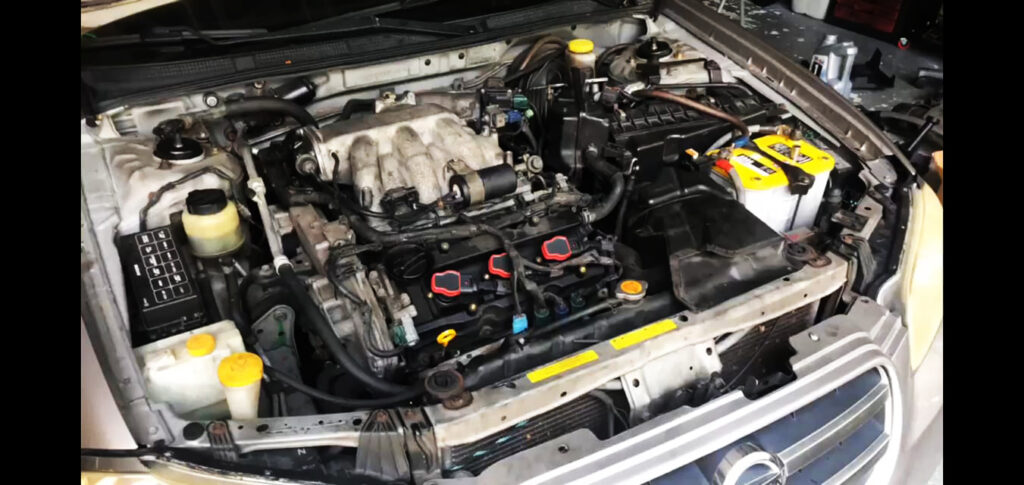
For future problem solvers, my 2003 Maxima brake and battery lights were flickering. The lights were eventually solid with no battery charge leading to believe an alternator problem. Went through the process of replacing the alternator with a remanufactured unit from Advance Auto. I got everything back together and the battery still wasn’t charging.
I realized the Alternator ground bracket was corroded as can be. Being my first time diagnosing my electrical system I’m now understanding the need for all clean & tight connections. I ended up getting out the multimeter to test continuity and it was so corroded in many spots there was none. I cleaned connections with a silver wire brush on drill brought it from 4v to 14.5v on the new alternator.
In case you’ve disrupted your throttle body and need to perform the Idle Air Volume Relearn, you’ve probably noticed that it doesn’t “stick” , meaning it worked fine for the time being and then it didn’t.
I am using the Nissan Data Scan app with an ELM obdii Bluetooth adapter, the car’s 2000 Maxima GLE.
In order to make the Idle Air Volume Relearn stick using any of those apps and Bluetooth adapters, you can’t wipe any pending codes before/after Relearn is performed; for some reason when you use a third party app instead of Nissan Consult, it’ll write the changes onto the same partition as the error codes. What that means is you’re gonna write the IAVR over any pending existing codes in order to make it stay.
1. Don’t wipe any codes or clear the SES light
2. Perform idle air volume relearn
It’ll stay on your ECU as long as there is a pending code or the SES light is on. Once you clear the code and the SES light, your idle air relearn goes away as well. If you clear your codes and then do the relearn, your relearn will get overwritten once the code comes back. If you do the relearn with a pending code, it’ll stay there along with the code.
I have been getting a few PMs on this from time to time, but most questions have been answered somewhere in this thread, take some time and read because there is alot of good info in here from people other than me. I swapped only two coils in Jan of 2006 and through Oct 2007 have not had a single problem with any additional coils. If you can isolate the bad coil, why replace all 6?
Sooooooo, I had the frigging SES, TCS, SLIP lights which any 5th gen owner should now know is code P1320, which means, drum roll please, Bad Ignition Coil. I was also luckily enough not just to have code once, but twice and also to have a code P0300, which is multiple misfires. I was able to get the codes pulled for free from my Autozone and so I started my quest to fix my car.
Some background info: The original coils from Nissan are garbage and Nissan knows this, yet they have chosen to do nothing about it. They did however update the coils with “newer” ones with a gray dot, that were supposed to be awesome. Well I open my hood, take off the cover and guess what, all my coils have gray dots. So I guess that blows that idea up. I bought my car in 2003 with 80k in miles from Woodfield Nissan in Illinois. So at some point in time they had already been replaced.
Ok, back to my test, I donated to Maxima.org so I could search and spent a night reading about just bad coils. The general consensus is that you should replace all 6 when one goes bad. The rough best price was about $300 for all six. The only problem is that I have this in my life right now that causes me to be short on money.
So after reading, I found a few things that will help in changing just the bad coils as I have done. I can not take credit for this info as pretty much all of it has been tried before, I am just trying to make it as easy as possible for everyone else.
Step #1 – Autozone
You may be lucky enough to have an additional code stored in your cars computer. If you have code P1320 with any P0301, P0302, P0303, P0304, P0305 or P0306, that is a misfire on specific cylinder. You now know which one is bad just replace that one, see the pics below on how to remove the coil.
Step 2 – Unplug coil one at a time
Remove your cover by taking the four bolts off your cover, you will need a 4mm allen wrench.
This test will only work if your engine is running really bad idle. If your SES/TCS/SLIP only come on when your engine is under load this test will not work, skip to step 3. My engine was running really rough even at idle, so I started to unplug the coils on at a time. Just squeeze the clip and pull, it will come off.
The first one I tried cylinder #2, when unplugged, made no difference at all in how the engine ran. SO I instantly knew that one was bad. If your coil is good you engine will bog down and almost stall, as you are basically removing a running cylinder. Do this one at a time until you find the one, that when removed, your engine does not seem to run any rougher.
Step 3 – Testing the resistance
You will need a multimeter to do this. I have had mine for a while and it worked fine for this. Its nothing big, and you can pick mine up at Sears for only $19.99. Remove all your coils.
The front three coils are right there held in by one 10mm bolt each. Unplug the clip, remove the bolt and pull. The coil will come right out.